
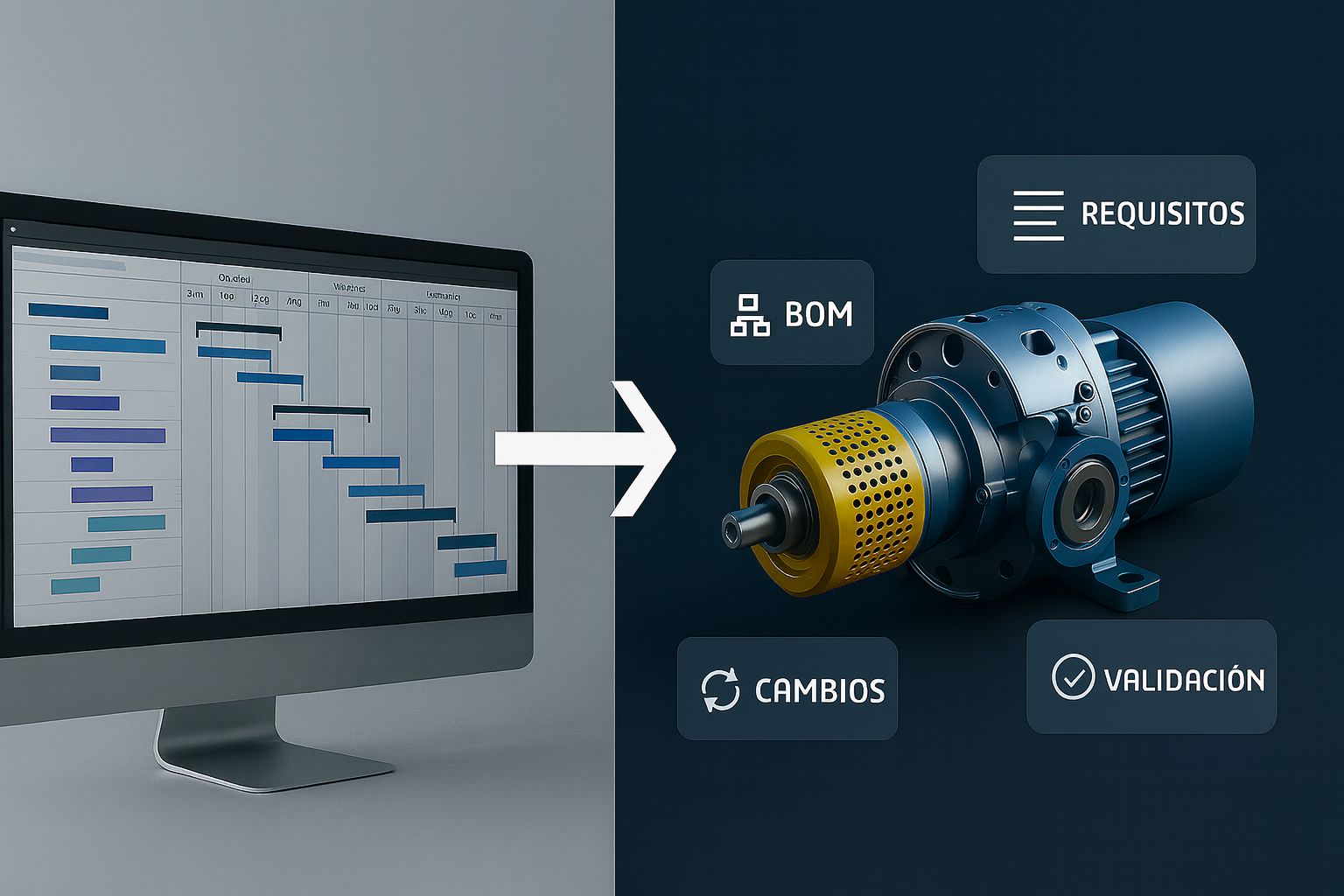
For years, many industrial companies have managed their projects using Gantt-type scheduling tools. Well-known solutions have been key to organizing tasks, timelines, dependencies, and resources.
That approach works very well when the main challenge is coordinating activities. But when the project involves developing an industrial product, the requirements go one step further: beyond the schedule, you need to govern product definition, versions, changes, and traceability. That’s where an end-to-end platform like 3DEXPERIENCE adds a different layer.
Below are five approach differences that explain that leap.
1. The project’s center: tasks vs product
Gantt tools are designed to answer questions such as:
what tasks need to be done, who does them, and when they must be completed.
In product development, the focus is not only on tasks, but on the product itself:
what is being designed, which version, which configuration is valid, and which deliverables are approved.
The practical difference is simple:
a schedule organizes work; an end-to-end platform governs product evolution.
2. Parallel planning vs planning connected to technical reality
In a Gantt-based approach, the plan usually lives on one side and the technical definition of the product on another (CAD models, documentation, product structure). This makes sense, as these tools focus on scheduling.
In 3DEXPERIENCE, project progress is connected to the real product structure and its maturity states. Progress is not measured only by how much work has been done, but by what product is actually defined, validated, and released.
This reduces the gap between “what is planned” and “what the product actually allows.”
3. Schedule control vs engineering traceability
Traditional tracking makes it possible to see deviations, delays, and team workload. It is essential for day-to-day management.
But an industrial project also requires technical traceability:
which version was approved, what change was made, why it was made, who validated it, and with what evidence.
That traceability is not an add-on in 3DEXPERIENCE. It is built in because it is a natural part of managing a product.
4. Deliverables as documents vs connected engineering data
In a Gantt-based model, deliverables are usually managed as attached documents, links, or folders associated with tasks.
In engineering, real work is an ecosystem of connected data:
parts, assemblies, variants, requirements, simulation results, validations, BOMs.
3DEXPERIENCE manages these relationships natively and connects product definition with CAD tools such as CATIA and SOLIDWORKS, as well as simulation and product structure. Everything is linked in a single digital thread, without relying on “loose files.”
5. Activity-based coordination vs end-to-end collaboration on the product
Gantt tools coordinate teams around activities and dates. It is an effective approach for managing effort.
An end-to-end platform enables collaboration around the product, not just tasks.
Multiple teams work simultaneously on the same digital definition, with version control, change management, and real-time visibility.
This makes a critical difference when there are thousands of components, multiple variants, involved suppliers, and continuous changes.
Conclusion
Gantt-based scheduling tools have been and continue to be very valuable for structuring tasks, timelines, and resources. Their role is to organize work through the schedule.
But in engineering projects, managing the schedule well does not guarantee managing the product well.
Industrial development requires a single, controlled, and traceable definition, with digital continuity between design, validation, and manufacturing.
That is the logic of end-to-end: the project is not just a plan, it is a product that evolves with rigor.
And when the project is a product, the platform must understand the product.
Does your project management start in a Gantt but end in emails, copies, and version confusion?
CADTECH Communications Department
comunicacion@cadtech.es – 800 007 177