
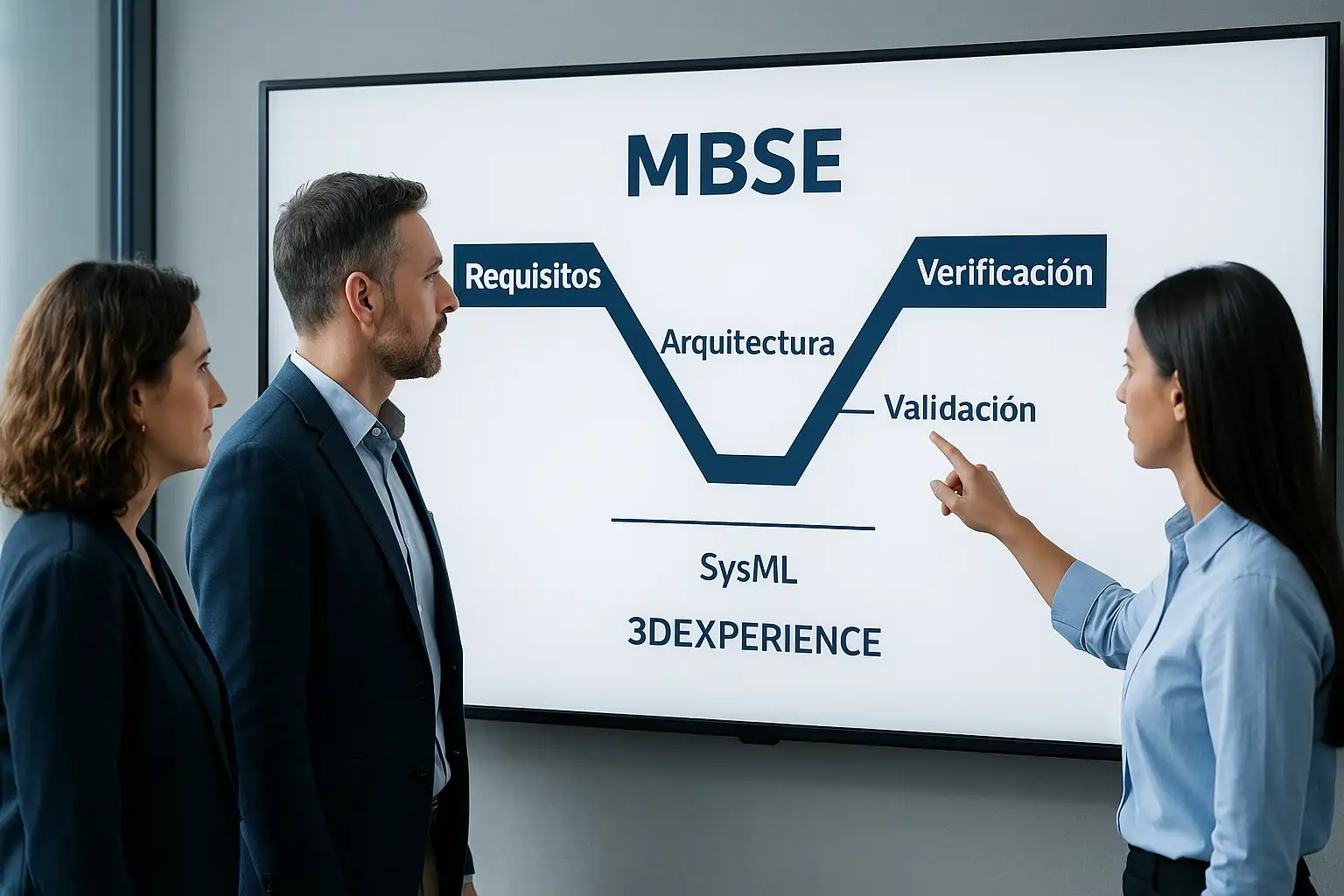
The most common question when talking about Model-Based Systems Engineering (MBSE) is easy to ask but hard to answer: where do I start?
The reality is that MBSE is not a quick recipe, but a combination of processes, methodologies, roles, responsibilities, governance, and deliverables. Added to this are software tools, which bring their own complexity. For those just starting out, the landscape can feel overwhelming.
This article proposes a practical and progressive path to take the first steps in MBSE without getting lost along the way.
1 – Distinguishing SE and MBSE
A common mistake is to think that Systems Engineering (SE) and MBSE are the same thing.
- SE: it is the process for developing a product’s lifecycle.
- MBSE: it is the methodology that documents and supports that process using languages and tools such as SysML.
Without understanding SE, jumping straight into MBSE is like trying to build a house starting with the roof.
2 – Start with the basics: the V-Model
The V-Model provides a simple and didactic representation of product development:
- Requirements capture
- Architecture definition
- Implementation
- Verification
- Validation
It is a framework that is easy to understand and applicable to mechanical, electrical, electronic, and software projects alike.
3 – Mapping the V-Model with ISO/IEC 15288
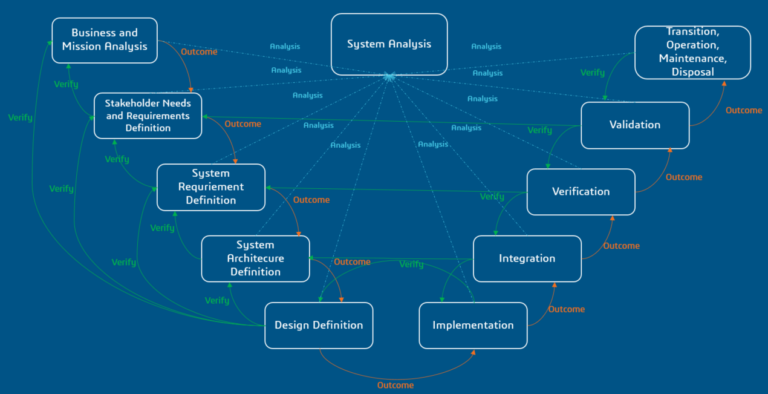
Once the V-Model has been understood, it is useful to connect it with the ISO/IEC 15288 standard: Systems and Software Engineering — System Life Cycle Processes.
For example:
- BMA (Business & Mission Analysis), STNRD (Stakeholder Needs & Requirement Definition), and SRD (System Requirement Definition) correspond to the requirements phase in the V-Model.
- The standard adds more detail: stakeholder identification, use case definition, validation criteria, and so on.
This exercise makes it possible to go deeper into the technical aspects without losing the overall perspective.
4 – Introducing SysML into the process
The next step is to learn how to capture process information using SysML. This language allows you to model requirements, identify stakeholders, define use cases and tests, analyze risks, compare alternatives, describe architectures, and trace validation.
At first it may seem complex, but the value it delivers is enormous. A common mistake is to start directly with SysML without first understanding systems engineering processes: this is where many frustrations come from.
5 – Integrating MBSE with the development ecosystem
MBSE does not end with SysML. Its true power emerges when that information is connected to other processes:
- PLM for mechanical design
- ALM for software development
- Simulation and verification tools
All of this makes even more sense when working on an integrated platform that ensures end-to-end traceability. One example is 3DEXPERIENCE, which allows engineering, design, simulation, and management processes to converge in a single environment.
Conclusion
Getting into MBSE may seem challenging, but with a clear path—understanding SE, practicing the V-Model, connecting it with ISO/IEC 15288, learning SysML, and integrating platforms—it becomes a natural evolution of product development.
More than a trend, MBSE is a way to gain rigor, collaboration, and efficiency in systems engineering. The first step is not learning a tool, but understanding the process we want to improve.
CADTECH Communications Department
comunicacion@cadtech.es – 800 007 177