
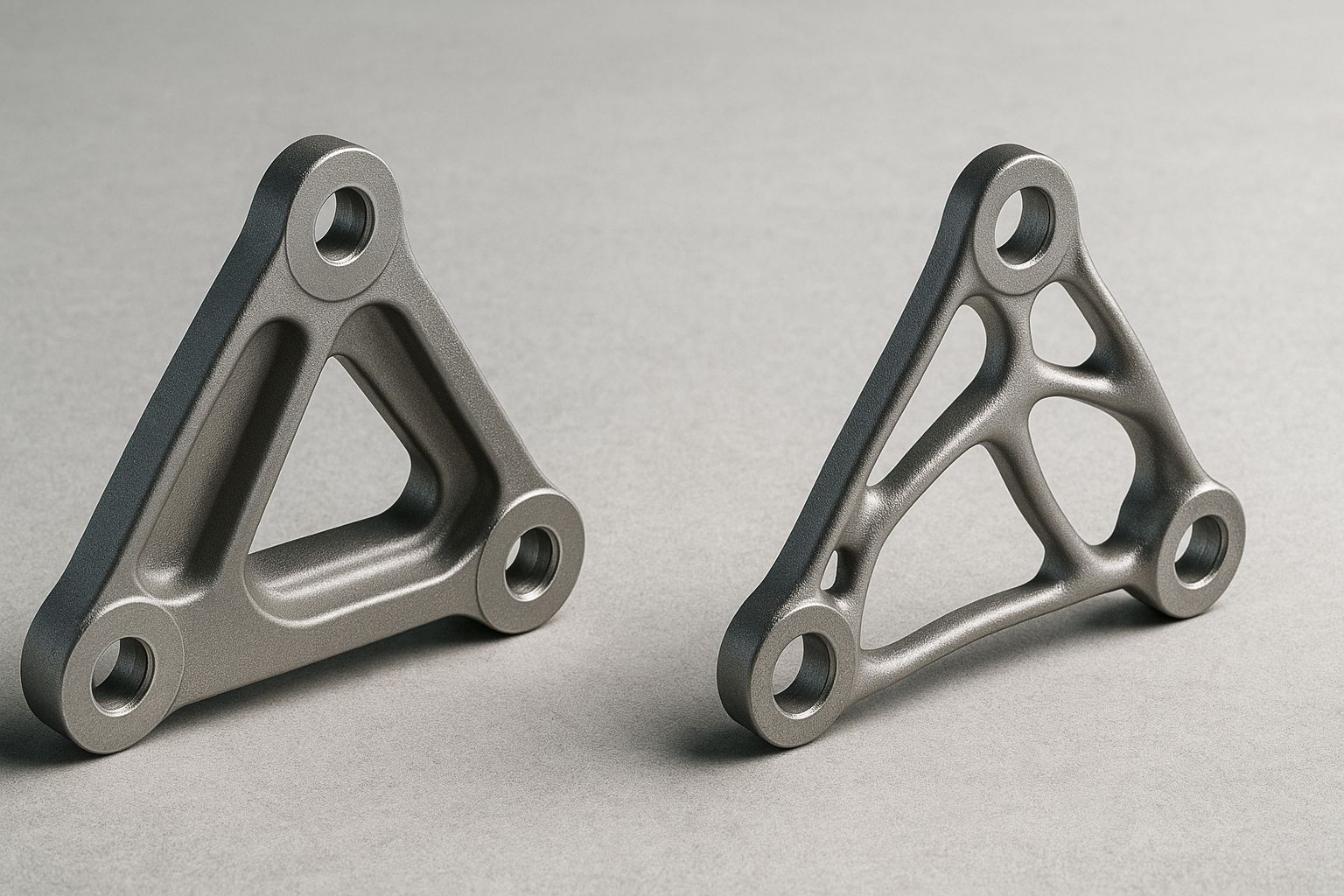
In the race to innovate, industrial companies seek not only to improve the performance of their products, but to do so responsibly. Sustainability is no longer a slogan: today it is a decisive criterion for winning projects, complying with regulations, and meeting new market demands.
In this context, generative design is establishing itself as a key tool. And with TOSCA, the structural optimization solution from Dassault Systèmes’ SIMULIA portfolio, companies can make a qualitative leap: designing lighter, stronger parts with a lower carbon footprint.
What is generative design
Generative design is based on an approach that differs from traditional design.
Instead of “drawing” a geometry from scratch, the engineer defines constraints, loads, and objectives.
The software automatically generates multiple optimized options to meet those requirements, giving the designer the ability to select the most suitable geometry, ready for manufacturing and validation.
This process not only accelerates innovation, but also opens the door to structural solutions that would hardly emerge through manual methods.
TOSCA: Structural optimization for a more sustainable world
TOSCA applies advanced structural optimization algorithms to generate designs that combine maximum strength with minimal material usage.
- Optimized topology: removes material where it adds no value and reinforces critical areas.
- Ready for additive manufacturing: generates lightweight, complex geometries ready for 3D printing.
- Significant weight reduction: with a direct impact on energy consumption and emissions throughout the lifecycle.
- Real sustainability: using less material results in a lower carbon footprint during production.
Direct impact on the company’s sustainability
Adopting TOSCA and generative design not only improves products, but also enhances business competitiveness:
- Lower carbon footprint: materials and energy optimized throughout the entire lifecycle.
- Greater mobility efficiency: lighter vehicles with increased range or lower consumption.
- Advances in aeronautics: aircraft that fly farther while consuming less fuel.
- Differentiating innovation: disruptive designs that better position the company in tenders and strategic projects.
Practical example
Let’s imagine a structural component in the automotive industry.
With a traditional design, the weight can exceed energy efficiency limits.
With TOSCA, the part is optimized by reducing up to 20–30% of the material used without compromising its strength.
The result: a lighter vehicle that consumes less and emits less CO₂ throughout its entire service life.
Conclusion
Sustainability is not achieved through good intentions alone: it is designed from the very beginning.
TOSCA combines generative design and structural optimization to help companies reduce material, energy, and emissions, achieving products that are more competitive and environmentally responsible.
Because in the engineering of the future, every gram counts.
Do you want to discover how TOSCA can help you design lighter and more sustainably?
CADTECH Communications Department
comunicacion@cadtech.es – 800 007 177