
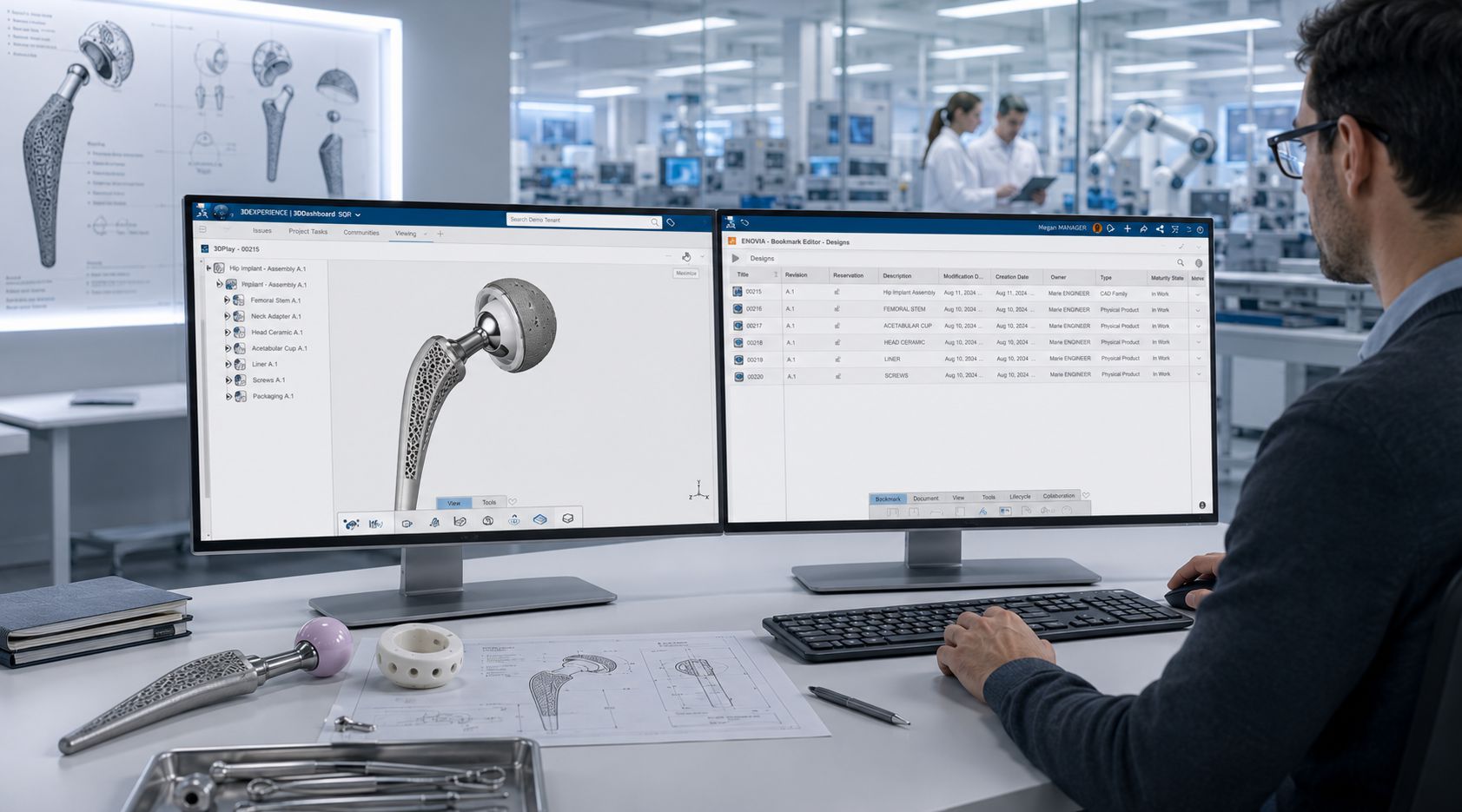
Digital transformation in Life Sciences has turned compliance into a strategic priority
The pharmaceutical, biotech, and medical device industries are accelerating their digitalization processes to reduce development times, improve quality, and increase product traceability. However, this evolution also brings new regulatory challenges.
Every electronic record, digital signature, manufacturing document, or data associated with GxP processes must strictly comply with the requirements established by the Food and Drug Administration (FDA) regarding integrity, security, and traceability.
In this context, FDA 21 CFR Part 11 has become one of the main regulatory frameworks for Life Sciences organizations working with computerized systems.
The problem is that many companies still manage quality and compliance through disconnected tools, scattered documentation, and manual processes that are difficult to audit.
The consequence is clear: greater regulatory complexity, higher document risk, and increasingly demanding audits.
For this reason, more and more organizations are adopting integrated platforms such as Dassault Systèmes’ 3DEXPERIENCE, capable of connecting quality, documentation, traceability, and compliance within a single digital environment.
What is FDA 21 CFR Part 11?
FDA 21 CFR Part 11 is the Food and Drug Administration regulation that defines the requirements applicable to electronic records, electronic signatures, and computerized systems used in regulated environments.
Its objective is to ensure that digital data has the same validity, reliability, and security as paper records.
The regulation particularly affects Life Sciences organizations operating under GxP environments, including:
- pharmaceutical companies,
- medical device manufacturers,
- biotech companies,
- laboratories,
- CROs and CDMOs,
- GMP manufacturers,
- pharmaceutical packaging companies.
In practice, FDA 21 CFR Part 11 requires companies to demonstrate that electronic information is integral, traceable, secure, and protected against unauthorized modifications.
What does FDA 21 CFR Part 11 really require?
One of the major challenges of FDA 21 CFR Part 11 is that it is not limited only to implementing electronic signatures or storing digital documentation.
The regulation requires building an environment capable of ensuring data integrity throughout the entire information lifecycle.
This means organizations must be able to demonstrate:
- who performed each action,
- when it occurred,
- what information was modified,
- under which permissions the change was executed,
- and how complete process traceability is maintained.
To achieve this, the regulation establishes requirements related to audit trails, access control, computerized system validation, document management, and the security of electronic records.
In addition, electronic signatures must be unique, verifiable, and unequivocally linked to the corresponding record.
All of this turns FDA compliance management into both a technological and regulatory challenge.
The main challenges of complying with FDA 21 CFR Part 11
Many Life Sciences companies still work with fragmented ecosystems made up of Excel files, isolated documents, disconnected tools, and manual processes.
Although this model may work initially, it becomes extremely complex when the organization needs to face FDA audits, manage CAPAs, demonstrate traceability, or respond to regulatory incidents.
Among the most common problems are:
- difficulty ensuring data integrity,
- lack of end-to-end traceability,
- decentralized document management,
- manual approval processes,
- versioning errors,
- slow and costly audits,
- difficulty validating computerized systems.
The FDA itself has increased its focus on issues related to documentation, data integrity, and digital quality management.
For this reason, Life Sciences companies are evolving toward platforms capable of centralizing regulatory processes, quality, and documentation within a single validated environment.
How 3DEXPERIENCE helps comply with FDA 21 CFR Part 11
The 3DEXPERIENCE platform from Dassault Systèmes makes it possible to build a connected digital ecosystem to manage quality, traceability, and regulatory compliance within a single platform.
Its integrated approach facilitates compliance with FDA 21 CFR Part 11 by connecting documentation, workflows, quality processes, validations, and regulatory evidence within a centralized environment.
Audit trail and complete traceability
One of the most critical requirements of FDA 21 CFR Part 11 is the ability to demonstrate full traceability for any regulated data or document.
3DEXPERIENCE incorporates audit trail mechanisms that automatically record changes, control versions, and maintain a complete document history.
This facilitates traceability from initial requirements through manufacturing, quality, and final product release.
In addition, centralizing information within a single platform greatly reduces the risk of document loss or inconsistencies during FDA audits.
Secure management of records and electronic signatures
The platform integrates user authentication, role-based permissions, and approval workflows that enable the secure management of electronic records and electronic signatures.
This helps ensure that only authorized users can access, modify, or approve critical information within the system.
At the same time, digital evidence is automatically linked to each process, improving auditability and reducing compliance risks.
Integrated document management and Quality Management
One of the main problems in regulated environments is document dispersion.
With 3DEXPERIENCE, elements such as SOPs, CAPAs, deviations, NCRs, changes, and audits are connected within the same digital ecosystem.
This makes it possible to eliminate organizational silos and improve collaboration between quality, engineering, regulatory, and manufacturing departments.
In addition, having a single source of information greatly simplifies the preparation of audits and regulatory inspections.
Continuous compliance and digital validation
FDA 21 CFR Part 11 also requires demonstrating that computerized systems operate correctly and fulfill their intended use.
3DEXPERIENCE facilitates this process through automated workflows, evidence management, document tracking, and reporting tools focused on continuous compliance.
The platform makes it possible to maintain a global view of the regulatory status of processes and prepare FDA audits much more quickly and efficiently.
From reactive Quality Management to predictive compliance
The Life Sciences industry is evolving toward much more proactive and connected quality models.
It is no longer only about reacting to deviations or non-conformities, but about anticipating risks before they generate regulatory or business impact.
In this scenario, platforms such as 3DEXPERIENCE incorporate advanced capabilities in analytics, risk management, artificial intelligence, and quality monitoring that make it possible to evolve toward predictive compliance strategies.
The goal is to transform quality into a strategic element throughout the entire product lifecycle.
Benefits of implementing FDA 21 CFR Part 11 with 3DEXPERIENCE
Digitalizing regulatory compliance through an integrated platform brings clear advantages for Life Sciences organizations:
- reduction of regulatory risks,
- faster FDA audits,
- improved data integrity,
- document automation,
- greater traceability,
- elimination of organizational silos,
- improved collaboration between quality, engineering, and manufacturing,
- scalability of digital compliance.
In addition, having a connected environment makes it possible to accelerate internal processes and significantly reduce the operational complexity associated with regulatory management.
FAQ — FDA 21 CFR Part 11
What does FDA 21 CFR Part 11 require?
The regulation requires that electronic records and electronic signatures used in regulated environments be secure, traceable, verifiable, and auditable.
What is an FDA audit trail?
It is the automatic history that records all changes made to regulated data and documents, including user, date, time, and modifications performed.
Which systems must comply with FDA 21 CFR Part 11?
All computerized systems used in FDA-regulated processes or within GxP environments.
How does a PLM help with FDA compliance?
A PLM makes it possible to connect quality, documentation, traceability, workflows, and regulatory management within a single digital platform.
Does 3DEXPERIENCE help comply with FDA 21 CFR Part 11?
Yes. The platform incorporates traceability, document management, audit trail, workflows, and quality control functionalities designed for regulatory compliance in Life Sciences.
How CADTECH can help you
Implementing a digital compliance strategy in Life Sciences is not only about deploying a technology tool. The real challenge lies in connecting quality, processes, traceability, and regulatory requirements within a validatable and scalable environment.
At CADTECH, we help pharmaceutical, biotech, and medical device companies design and implement 3DEXPERIENCE environments prepared to comply with regulations such as FDA 21 CFR Part 11, ISO 13485, ISO 15378, or Annex 11.
Our team supports organizations in the digitalization of quality processes, document management, traceability, and regulatory compliance, adapting the platform to the specific requirements of each Life Sciences environment.
CADTECH Communications Department
comunicacion@cadtech.es – 800 007 177