
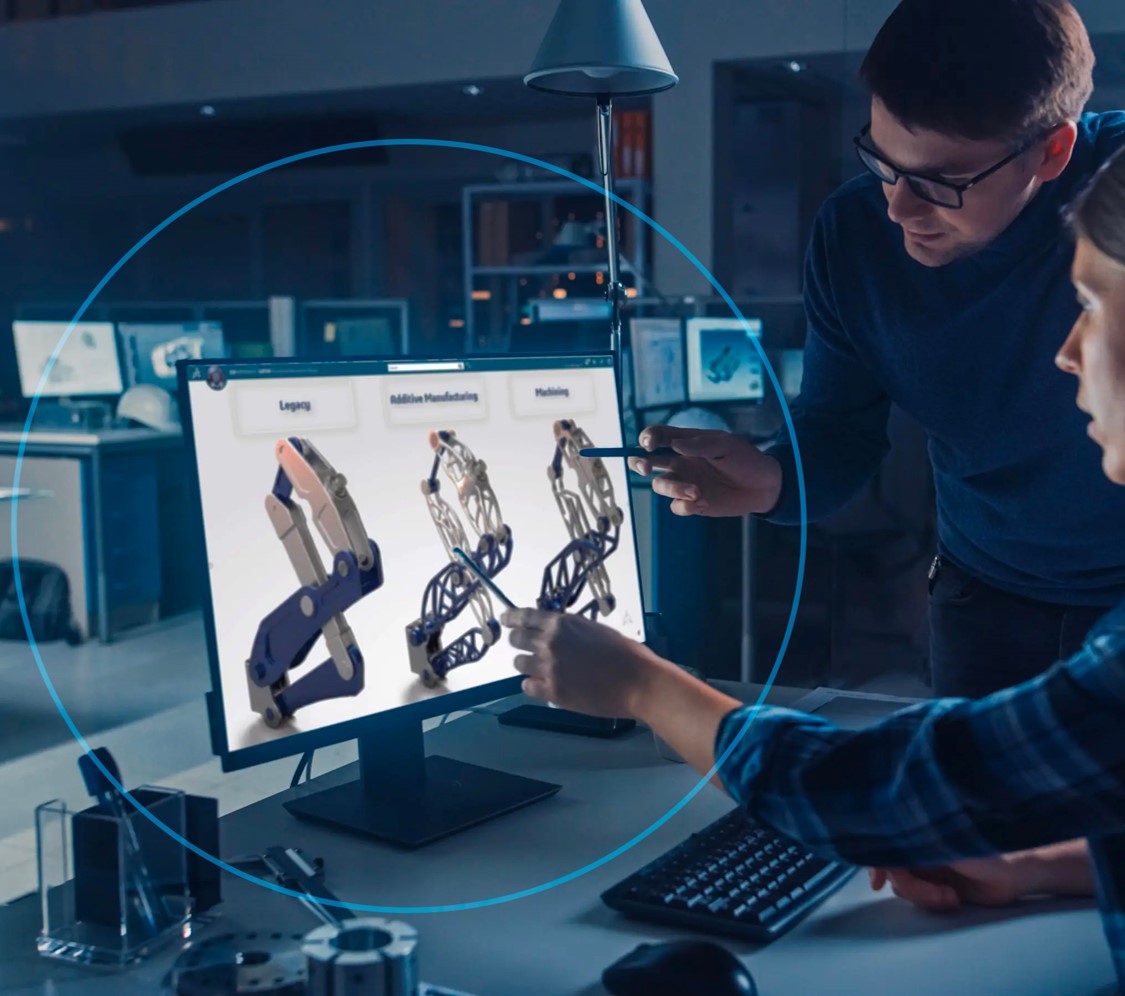
Artificial intelligence (AI) is no longer a futuristic promise—it’s a day-to-day reality for engineers. With the rise of generative AI, industrial design has taken a qualitative leap forward: it’s now possible to create innovative concepts, optimize structures, and accelerate product development on timelines that were unthinkable just a few years ago.
CATIA incorporates a unique generative AI approach based on machine learning and deep learning, trained with industry-specific data. The result: solutions that combine engineering know-how, industry expertise, and intelligent algorithms to tackle the biggest product development challenges.
Tangible Benefits of AI in CATIA
Generative AI in CATIA is not a future promise—it’s a proven, applied technology already delivering measurable results in engineering.
Thanks to automation, geometric pattern learning, and knowledge reuse, companies are achieving significant improvements in time, quality, and product performance.
- Up to 300% faster conceptual design phases
(For example: if it previously took 3 days to explore 10 structural variants, AI and topology optimization now make it possible in just 1 day.) - 10% reduction in warranty costs thanks to more robust designs
(AI-generated designs help anticipate critical points and reduce issues before final validation.) - 80% component reuse through standardization and modularization
(By integrating corporate knowledge with Knowledgeware, teams reuse validated templates and rules.) - Improved structural performance with high-performance designs
(AI-driven bionic optimization delivers lighter, stronger structures while maintaining the required stiffness for each application.)
Practical Applications in Engineering
Generative AI capabilities in CATIA go beyond task acceleration—they transform how engineers conceive, evaluate, and bring designs to life.
From structural optimization to exploring thousands of alternatives in just hours, AI expands both the creative and technical potential of engineering teams.
- Optimized topology → lighter, stronger parts and assemblies
- Body & Chassis → exploration of thousands of early-stage alternatives for electric vehicle platforms
- Multi-material studies → optimization of composite aircraft wings or hybrid structures that combine strength and lightness
- No-code visual scripting → accessible algorithmic design to quickly and collaboratively explore multiple variants
AI Serving Sustainability and Complexity
Modern design is no longer just about quality and cost. Factors such as carbon footprint and the integration of software into increasingly intelligent products add new layers of complexity.
With the support of generative AI, CATIA enables teams to:
- Evaluate the environmental impact of a product throughout its lifecycle
- Design software-defined products by coordinating hardware and software in parallel
- Meet sustainability regulations without compromising innovation
How Does CATIA Integrate Artificial Intelligence?
In this video, Daniel Pyzak (Dassault Systèmes) answers the most frequently asked questions about how CATIA uses AI and generative design to accelerate product development.
FAQs about AI in CATIA
Why use AI in industrial design?
Because it enables industrial companies to accelerate product creation, automate repetitive tasks, and reduce errors from the earliest stages of development.
What is Knowledgeware and what value does it bring?
Knowledgeware is a technology integrated into CATIA that enables companies to embed their own rules, standards, and expertise directly into the design process. It makes it easier to create engineering templates, validate designs, and automatically reuse know-how, ensuring consistency across projects.
What role does topology optimization play in CATIA’s AI?
Topology optimization helps design lightweight, high-strength parts using algorithms that generate optimized, bionic shapes. AI makes it possible to automatically adapt these results to the selected manufacturing process (machining, 3D printing, casting, etc.).
What AI techniques are used?
CATIA uses machine learning and deep learning to recognize geometric patterns, automate tasks, and optimize structural design decisions. These capabilities are continuously expanded within the 3DEXPERIENCE platform.
Which roles benefit from these capabilities?
Mechanical designers, data analysts, and simulation specialists can integrate AI into their daily workflows, enabling them to design better, faster, and with greater accuracy.
In short, the entire organization benefits: engineering teams reduce lead times, quality teams validate earlier, and management gains a more agile, connected view of the product development process.
Would you like to explore how to apply AI to your design process?
CADTECH Communications Department
comunicacion@cadtech.es – 800 007 177