

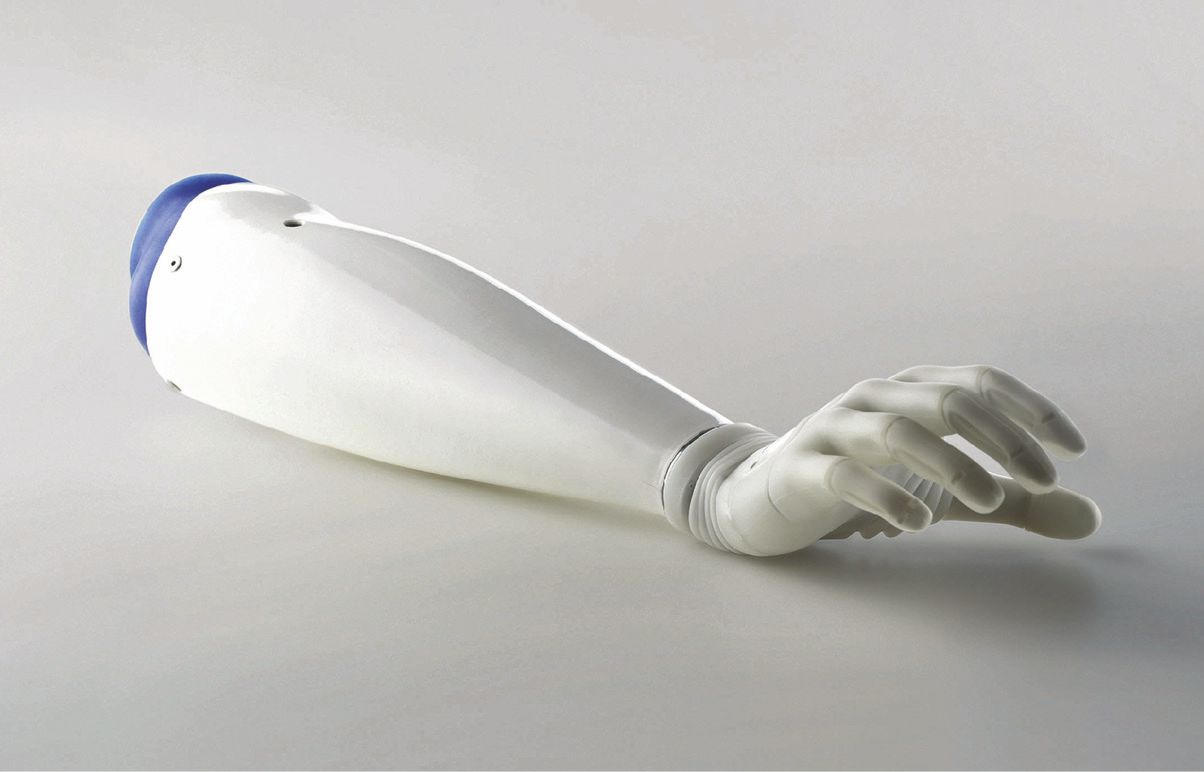
(Photo © Otto Bock)
Ottobock Healthcare Products GmbH, a global leader in medical technology, chose the 3DEXPERIENCE platform from Dassault Systèmes — including CATIA Imagine & Shape — to optimize the surface design of its prostheses and bring them even closer to the complexity and naturalness of the human body. The goal: for the prosthesis not only to function precisely, but for the user to feel it as a natural part of themselves.
Inspired by nature
Since its founding in 1919, Ottobock has maintained a clear vision: to improve the mobility of people with disabilities through innovative products. Beyond technical functionality, the company focuses on individuality, quality, and design.
Reproducing the natural movements of the human body poses an extraordinary challenge. Skin, wrinkles, elasticity, and the organic shape of a hand have no exact equivalent in artificial materials. In the case of the “Michelangelo” hand prosthesis, the challenge was not only technical but also aesthetic: designing a cover that would allow mobility, integrate functional wrinkles, and provide the most realistic appearance possible, even reproducing details such as the structure of the veins.
The prosthesis as a natural part of the body
Ottobock’s current prostheses are complex mechatronic systems. In the case of leg prostheses, they incorporate microprocessors that detect whether the user is sitting or climbing stairs, automatically adjusting movement to ensure safety and naturalness.
The Michelangelo prosthetic hand incorporates a wrist with a neutral position that allows smoother movement, reducing the feeling of stiffness. However, when attempting to redesign the external cover to make it even more realistic, the CAD system used by the Ottobock group reached its limits.
It was then that, following the recommendation of partner EBM, the company opted for the 3DEXPERIENCE platform and its freeform surface module CATIA Imagine & Shape. After its implementation and specialized training, the team began working on the new modeling.
(Photo © Otto bock – Open Up Arabesque glasses, Chef & Sommelier®)
Freedom to model natural shapes
In prosthesis design, creativity does not start from a free form, but from a clear reference: nature. The challenge lies in balancing technical requirements with fidelity to the organic form.
CATIA Imagine & Shape allowed designers to work with complex surfaces while ensuring continuity and smooth transitions between curves and adjacent surfaces. The stability of the model, even with small changes, gave the team greater confidence, enabling them to focus on modeling quality.
Direct surface manipulation through control points provided a much more intuitive and precise approach. This facilitated immediate acceptance by users, who were able to focus on designing more natural shapes without compromising the robustness of the model.
From two months to three weeks
The impact was immediate and measurable. Before incorporating CATIA Imagine & Shape, the team had worked for two months on the new geometry of the Michelangelo hand shell without achieving the desired result.
With the new solution, the model was completed in just three weeks.
Since then, CATIA Imagine & Shape has become Ottobock’s strategic tool for surface modeling in all products where form is an essential factor. The company continues to take nature as its reference, knowing that perfect design is still an evolving goal, but relying on technology to get ever closer to it.
Article based on the customer story published by Dassault Systèmes on its official website.
Access the full case here: https://www.3ds.com/insights/customer-stories/otto-bock-healthcare-products-gmbh
About Ottobock Healthcare Products GmbH
Medical technology company specializing in mobility solutions such as prostheses, orthoses, and medical services.
Headquarters: Duderstadt, Germany.
Employees: more than 7,500.
Revenue (2014): €1,018 million
More information: www.ottobock.com
CADTECH Communications Department
comunicacion@cadtech.es – 800 007 177