
(Photo © Dassault Systèmes)
The Challenge: Designing Increasingly Complex Antennas for 5G and 6G
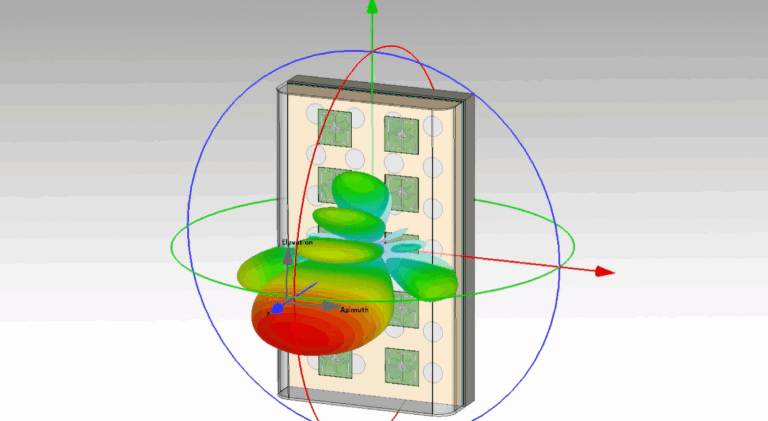
With the global rollout of 5G and the emergence of 6G, the design of advanced passive antennas is becoming increasingly complex. These systems operate with invisible electromagnetic waves, requiring engineers to rely on advanced simulation to visualize, analyze, and optimize performance with maximum precision.
Ericsson, one of the world’s leading providers of mobile connectivity solutions, faced two major challenges: the difficulty of simulating large-scale antenna systems within tight deadlines, and the decentralized management of massive volumes of simulation data. This made it difficult to locate the right information at the right time and limited collaboration across teams.
In addition, electromagnetic simulation results are expensive to generate and complex to store long term. Without a proper strategy, there is a real risk of losing critical intellectual property.
The Solution: Advanced simulation and centralized data management
To address these challenges, Ericsson implemented the 3DEXPERIENCE platform together with SIMULIA CST Studio Suite, a solution specialized in the design, analysis, and optimization of electromagnetic systems.
Key Process Improvements
- End-to-end simulation, from individual components to the full antenna system.
- Use of the Domain Decomposition Method (DDM) solver, which divides complex models into subdomains that can be solved in parallel, significantly reducing computation time.
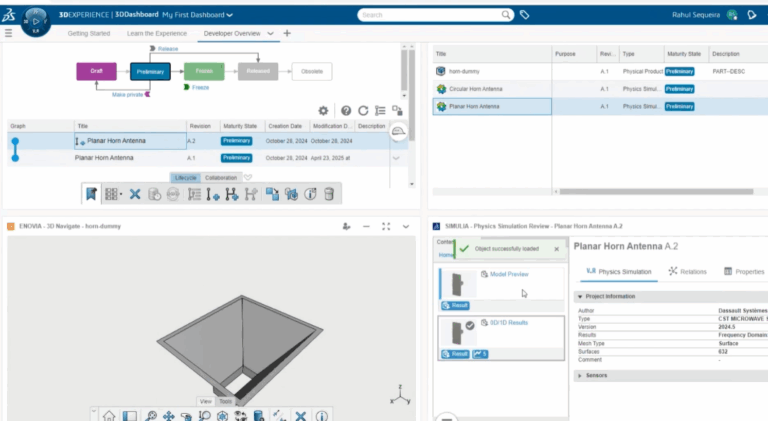
- Creation of a centralized database and an Antenna Component Library accessible to all stakeholders.
Impact on Collaboration, Traceability, and Knowledge Protection
Centralizing data enabled the establishment of an end-to-end design workflow, ensured full traceability (who developed what, when, and how), and democratized access to simulation data beyond technical experts.
This improves real-time decision-making, strengthens trust across teams, and protects the knowledge generated.
(Photo © Dassault Systèmes)
Results: Reduced Lead Times, Greater Efficiency, and AI Enablement
The results include reduced lead times, improved efficiency in simulating complex structures, enhanced collaboration, and a structured foundation that even supports artificial intelligence initiatives and predictive optimization.
In an industry where efficiency, capacity, and speed of innovation are critical, electromagnetic simulation is not just a technical tool — it is a strategic enabler. And this applies not only to major players like Ericsson, but also to technology startups and research centers developing the connectivity of the future.
Article based on the original publication:
Katie Corey
Editor, SIMULIA Blog
Dassault Systèmes
“Ericsson Accelerates Innovation with SIMULIA CST Studio Suite and the 3DEXPERIENCE Platform”
Available on the official SIMULIA Blog – Dassault Systèmes.
comunicacion@cadtech.es – 800 007 177