
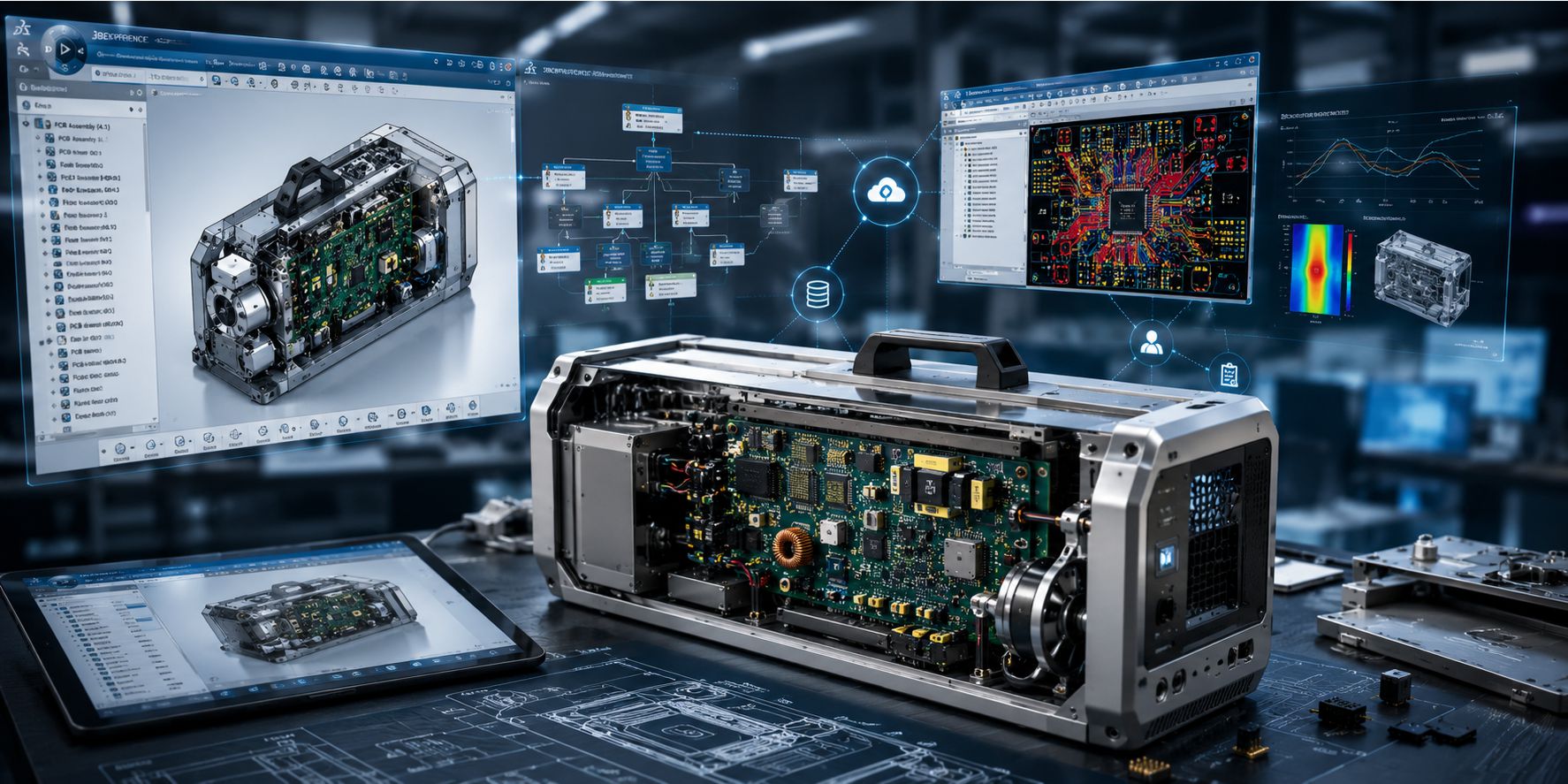
Modern electronic development can no longer work in isolation.
Today’s projects require continuous collaboration between:
- electronics,
- mechanics,
- simulation,
- manufacturing,
- supply chain,
- and product lifecycle management.
However, in many organizations, the ECAD environment remains disconnected from the rest of the engineering disciplines.
With ENOVIA Collaborative Designer for Altium Designer (UDT), Dassault Systèmes integrates PCB development carried out in Altium Designer into the 3DEXPERIENCE platform, creating a unified environment for multidisciplinary product development.
Much more than an ECAD connector
The goal of UDT is not to replace Altium Designer.
The real value lies in turning 3DEXPERIENCE into the collaborative core of the electronic project.
Thanks to this integration, designs developed in Altium become part of a connected ecosystem where the following converge:
- ENOVIA
- CATIA
- SOLIDWORKS
- SIMULIA / Abaqus
- DELMIA
- manufacturing
- supply chain
- corporate PLM processes
This approach is defined as a “federated product definition,” where all disciplines work on a single digital product definition.
3DEXPERIENCE as the central platform for electronic development
Collaborative Designer for Altium Designer allows the management within 3DEXPERIENCE of:
- schematics,
- PCB layouts,
- libraries,
- symbols,
- footprints,
- 3D models,
- manufacturing documentation,
- revisions,
- engineering changes,
- and dynamic configurations.
The platform acts as a single source of truth for the entire organization, eliminating silos between departments and reducing problems caused by outdated or inconsistent information.
Digital continuity between ECAD and MCAD
One of the strongest aspects of UDT is the direct collaboration between electronics and mechanics.
The integration allows PCB designs to be synchronized with MCAD environments and enables teams to work on a shared product definition.
This facilitates:
- space validation,
- interference analysis,
- enclosure integration,
- component positioning,
- electromechanical validation,
- and collaborative assembly review.
In addition, Altium can exchange STEP and Parasolid models to integrate with mechanical tools such as SOLIDWORKS or CATIA.

Integration with advanced simulation
As part of the 3DEXPERIENCE ecosystem, electronic designs can be directly connected to simulation solutions such as SIMULIA and Abaqus.
This makes it possible to address:
- thermal analysis,
- structural behavior,
- vibrations,
- deformations,
- electronic reliability,
- and virtual product validation.
Dassault Systèmes positions this integration within a global “High Performance Electronics” strategy, where electronics, simulation, and multidisciplinary optimization work within the same digital environment.
PLM management for PCB projects
With UDT, ECAD projects are no longer managed only as CAD files and become part of a complete PLM environment.
The solution incorporates advanced capabilities for:
- revision control,
- change management,
- approval workflows,
- document management,
- traceability,
- work-in-progress control,
- and design reuse.
It is even possible to work with multiple revision trees and associate modifications with Change Action processes within ENOVIA.
Intelligent management of electronic components
One of the common challenges in electronics is the proliferation of duplicate libraries and components.
Collaborative Designer allows the centralization of:
- symbols,
- footprints,
- 3D models,
- engineering representations,
- and reusable components.
Components can be developed and published directly within 3DEXPERIENCE, creating a corporate library connected to the rest of the engineering processes.
This improves:
- reuse,
- standardization,
- traceability,
- compliance,
- and collaboration between distributed teams.
Concurrent design and multidisciplinary collaboration
The solution also enables concurrent design methodologies for complex PCB projects.
Teams can work simultaneously on:
- schematics,
- layouts,
- libraries,
- and product structures.
The real-time collaboration capabilities and multi-user hierarchical design features stand out in particular for accelerating electronic development.
Manufacturing and continuity toward production
UDT is not limited to design and collaboration.
The platform also connects electronic data with downstream manufacturing and supply chain processes.
It is possible to generate and manage:
- netlists,
- artwork,
- drill data,
- drawing plots,
- manufacturing outputs,
- and production documentation directly from the managed environment.
This reduces transfer errors between engineering and manufacturing and accelerates product industrialization.
Conclusion
ENOVIA Collaborative Designer for Altium Designer takes ECAD development beyond traditional electronic design.
The integration of Altium Designer within 3DEXPERIENCE makes it possible to connect electronics, mechanics, simulation, and manufacturing within a single collaborative platform.
The result is true digital continuity for the product:
- with greater traceability,
- fewer errors,
- better multidisciplinary collaboration,
- and much more integrated and efficient development processes.
CADTECH Communications Department
comunicacion@cadtech.es – 800 007 177