
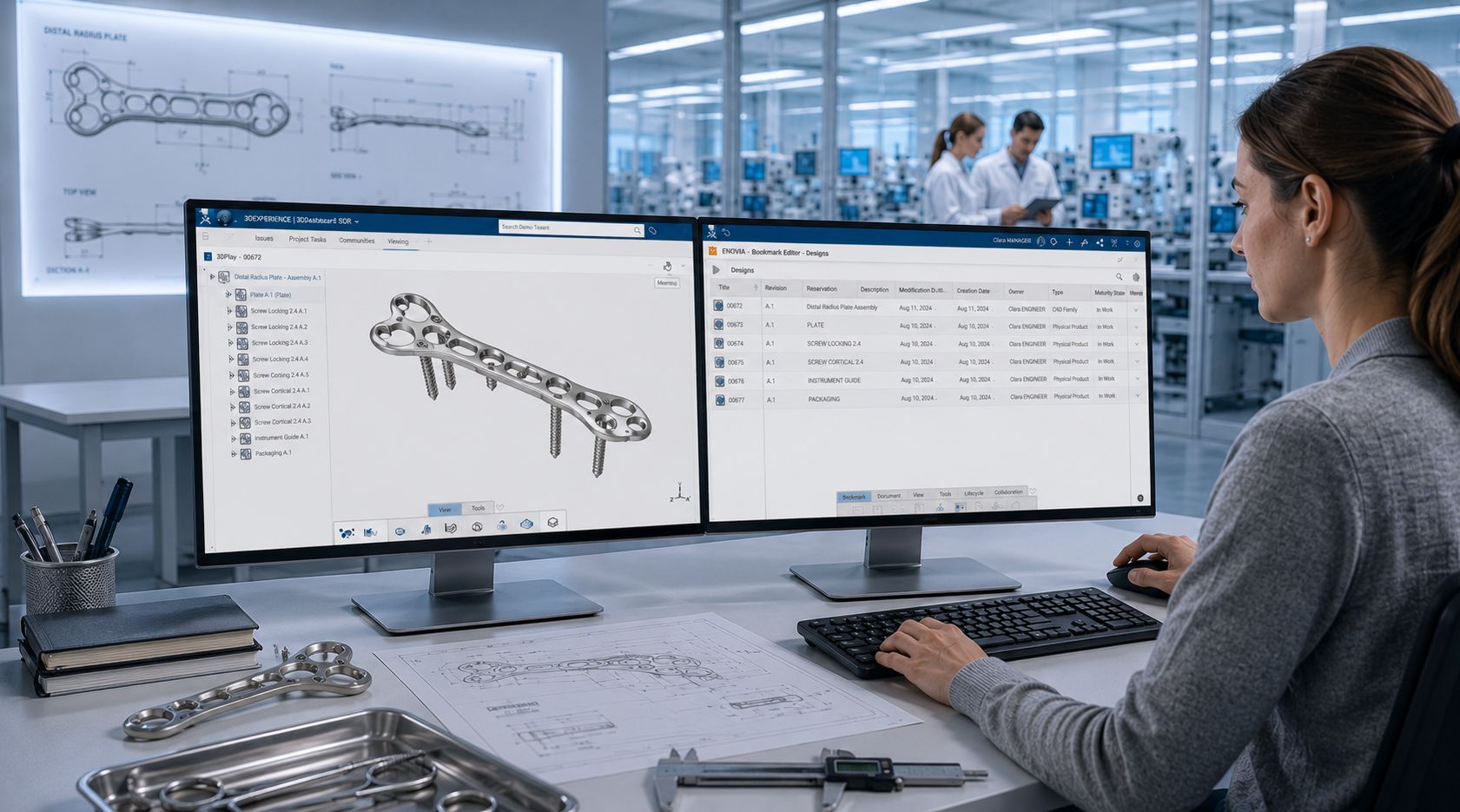
Regulatory pressure on medical device manufacturers continues to grow
The Medical Devices industry is undergoing an accelerated transformation driven by new regulatory requirements, shorter innovation cycles, and an increasing need for traceability and quality control.
Manufacturers no longer only need to develop safe and effective products. They must also continuously demonstrate that all their processes are controlled, documented, and aligned with international regulatory requirements.
In this context, ISO 13485 certification has become the key standard for ensuring a robust quality management system within the medical devices sector.
However, many organizations still manage quality through scattered documents, manual processes, and disconnected tools that make traceability more difficult and increase audit complexity.
For this reason, more and more companies are adopting digital platforms capable of connecting quality, engineering, risks, and manufacturing within a single collaborative environment.
What is ISO 13485?
ISO 13485 is the international standard that defines the requirements for quality management systems applied to medical devices.
Its objective is to ensure that organizations can develop, manufacture, and maintain healthcare products under controlled, traceable processes aligned with industry regulatory requirements.
The standard applies to manufacturers of:
- Medical devices,
- Healthcare software,
- In vitro diagnostics,
- Critical components,
- Healthcare packaging,
- Medical device supply chain providers.
ISO 13485 places a strong focus on aspects such as document management, change control, traceability, process validation, and risk management throughout the product lifecycle.
In addition, the standard has become a fundamental basis for facilitating compliance with international regulations such as the European MDR or the FDA in the United States.
What does ISO 13485 really require?
One of the most important aspects of ISO 13485 is that quality is no longer understood only as a final product inspection.
The standard requires building an integrated quality system capable of continuously and traceably connecting design, manufacturing, documentation, risks, and regulatory processes.
This means organizations must be able to demonstrate:
- complete document control,
- end-to-end traceability,
- structured risk management,
- change control,
- process validation,
- CAPA and non-conformity tracking,
- continuous quality monitoring.
In addition, any modification made to design, manufacturing, or documentation must be properly recorded and linked to the corresponding processes.
The challenge is not only passing audits, but maintaining a scalable quality environment prepared to respond quickly to inspections, incidents, or regulatory changes.
The main challenges of complying with ISO 13485
Many companies in the Medical Device sector still work with fragmented ecosystems where quality, engineering, and manufacturing operate on separate tools.
This creates common problems such as:
- decentralized documentation,
- difficulty maintaining complete traceability,
- manual CAPA management,
- versioning errors,
- lack of integration between design and quality,
- complex and slow audits,
- difficulty managing risks across the organization.
As regulatory requirements continue to increase, this model becomes increasingly difficult to sustain.
The digitalization of Quality Management has become a strategic priority for manufacturers that need to reduce regulatory risks and accelerate their innovation processes.
How 3DEXPERIENCE helps comply with ISO 13485
The 3DEXPERIENCE platform from Dassault Systèmes makes it possible to connect quality, engineering, manufacturing, and compliance within a single collaborative digital environment.
This approach facilitates the implementation of quality systems aligned with ISO 13485 requirements and improves traceability throughout the entire lifecycle of the medical device.
Integrated quality management
One of the main benefits of 3DEXPERIENCE is the ability to centralize quality processes within a single platform.
Elements such as CAPAs, NCRs, audits, deviations, document control, and change management are connected within the same digital ecosystem.
This reduces organizational silos and facilitates collaboration between quality, regulatory, engineering, and manufacturing departments.
In addition, having a single source of information greatly simplifies audit preparation and the management of regulatory evidence.
Risk management in Medical Devices
ISO 13485 requires the application of a risk-based approach throughout the entire product lifecycle.
3DEXPERIENCE makes it possible to identify risks, connect them to requirements, link validations, and automate preventive actions within the quality environment.
In this way, risk management stops being an isolated process and becomes directly integrated with design, manufacturing, and compliance.
This facilitates a much more complete view of the regulatory and operational impact of every decision.
Complete traceability of the medical device
Traceability is one of the fundamental pillars within ISO 13485.
The platform connects requirements, design, quality, manufacturing, validations, audits, and UDI processes within a continuous digital flow.
This makes it possible to respond much faster to:
- recalls,
- regulatory incidents,
- design changes,
- audits,
- quality investigations.
In addition, having end-to-end traceability greatly improves the ability to demonstrate compliance to regulatory bodies.
Digital audits and continuous compliance
Audits in Medical Devices are becoming increasingly demanding and require fast access to documentation, evidence, and traceability.
3DEXPERIENCE automates regulatory workflows, action tracking, quality reporting, and evidence collection within a centralized digital environment.
This significantly reduces the administrative burden associated with audits and improves the ability to maintain continuous compliance.
The platform enables the transition from reactive quality models to much more proactive and connected systems.
From traditional Quality Management to connected quality
The Medical Device industry is evolving toward digital models where quality, engineering, and manufacturing work in an integrated way.
The objective is no longer only to manage quality documentation, but to build an environment capable of connecting processes, people, risks, and data in real time.
Platforms such as 3DEXPERIENCE incorporate advanced capabilities for traceability, collaboration, analytics, and risk management that make it possible to transform the quality system into a strategic element for the organization.
This becomes especially important in a regulatory environment where response times, auditability, and traceability are becoming increasingly critical.
Benefits of implementing ISO 13485 with 3DEXPERIENCE
Digitalizing the quality system through an integrated platform brings clear advantages for medical device manufacturers:
- greater traceability,
- reduction of non-conformities,
- faster audits,
- better document control,
- integration between quality and engineering,
- digital CAPA management,
- greater visibility into risks,
- improved regulatory compliance.
In addition, connecting all areas within the same environment helps reduce errors and accelerate the development of compliant products.
FAQ — ISO 13485
Which companies must comply with ISO 13485?
Manufacturers and suppliers related to medical devices, healthcare software, and medical device technologies.
Is ISO 13485 mandatory?
It depends on local regulations and the target market, but in practice it is an essential standard for operating internationally.
What is the relationship between ISO 13485 and MDR?
ISO 13485 helps structure the quality system required to comply with the regulatory requirements of the European MDR.
How does a PLM help with ISO 13485 compliance?
A PLM connects design, quality, risks, documentation, and manufacturing within a traceable and audited environment.
Does 3DEXPERIENCE help comply with ISO 13485?
Yes. The platform integrates quality, traceability, document management, and compliance functionalities designed for the Medical Device sector.
How CADTECH can help you
Implementing a digital quality system aligned with ISO 13485 requires much more than centralizing documentation.
The real challenge lies in connecting quality, design, risks, manufacturing, and compliance within a platform capable of ensuring traceability and regulatory scalability.
At CADTECH, we help Medical Device, biotech, and Life Sciences companies implement 3DEXPERIENCE solutions prepared to comply with standards such as ISO 13485, FDA 21 CFR Part 11, ISO 15378, or the European MDR.
Our team supports organizations in the digitalization of quality, traceability, and regulatory management processes, adapting the platform to the specific needs of each industrial and healthcare environment.
CADTECH Communications Department
comunicacion@cadtech.es – 800 007 177