

Electromagnetic compatibility can no longer be validated only at the end
The growing complexity of modern electronic products has turned electromagnetic compatibility (EMC) and electromagnetic interference (EMI) into major engineering challenges during product development.
High-speed data transmission, power electronics, wireless connectivity, miniaturization, and increasingly integrated systems all increase the risk of emissions and interference that can compromise product performance, reliability, and certification.
In industries such as automotive, aerospace, industrial electronics, telecommunications, and medical devices, addressing EMC/EMI only during the final validation stages represents a growing technical and financial risk.
As a result, electromagnetic simulation is becoming a key tool for reducing uncertainty, accelerating validation, and preventing issues before physical prototypes are manufactured.
EMC and EMI: two closely connected concepts
Although they are often mentioned together, EMC and EMI do not mean the same thing.
EMI (Electromagnetic Interference) refers to the electromagnetic disturbances that a device can generate or receive, potentially affecting the operation of other electronic systems.
EMC (Electromagnetic Compatibility), on the other hand, describes a device’s ability to operate correctly within its electromagnetic environment without generating interference or being negatively affected by it.
In practice, achieving EMC means balancing emissions, immunity, and the overall electromagnetic behavior of the system.
Why EMC/EMI issues are becoming more complex
Modern electronics integrate multiple subsystems operating simultaneously within increasingly compact environments.
High-speed processors, power electronics, communication buses, antennas, sensors, and complex wiring systems coexist inside highly integrated architectures. This significantly increases the likelihood of unwanted electromagnetic phenomena.
Some of the most common EMC/EMI challenges include:
- Radiated emissions,
- Conducted emissions,
- Electromagnetic coupling,
- Electrostatic discharge,
- Immunity failures,
- Interference between subsystems,
- Signal degradation.
Many of these issues are not detected until advanced validation stages, when correction costs become significantly higher.
The cost of identifying EMC issues too late
In many projects, electromagnetic compatibility is still treated as a final validation step associated with laboratory testing.
The problem arises when the product fails EMC/EMI tests and late-stage design modifications become necessary.
PCB redesigns, wiring changes, shielding additions, filters, or component replacements can directly impact costs, development timelines, and industrial planning.
In addition, every extra iteration delays certification, validation, and time-to-market.
For this reason, more and more organizations are integrating electromagnetic analysis into the earliest stages of product development.
Electromagnetic simulation: a preventive approach
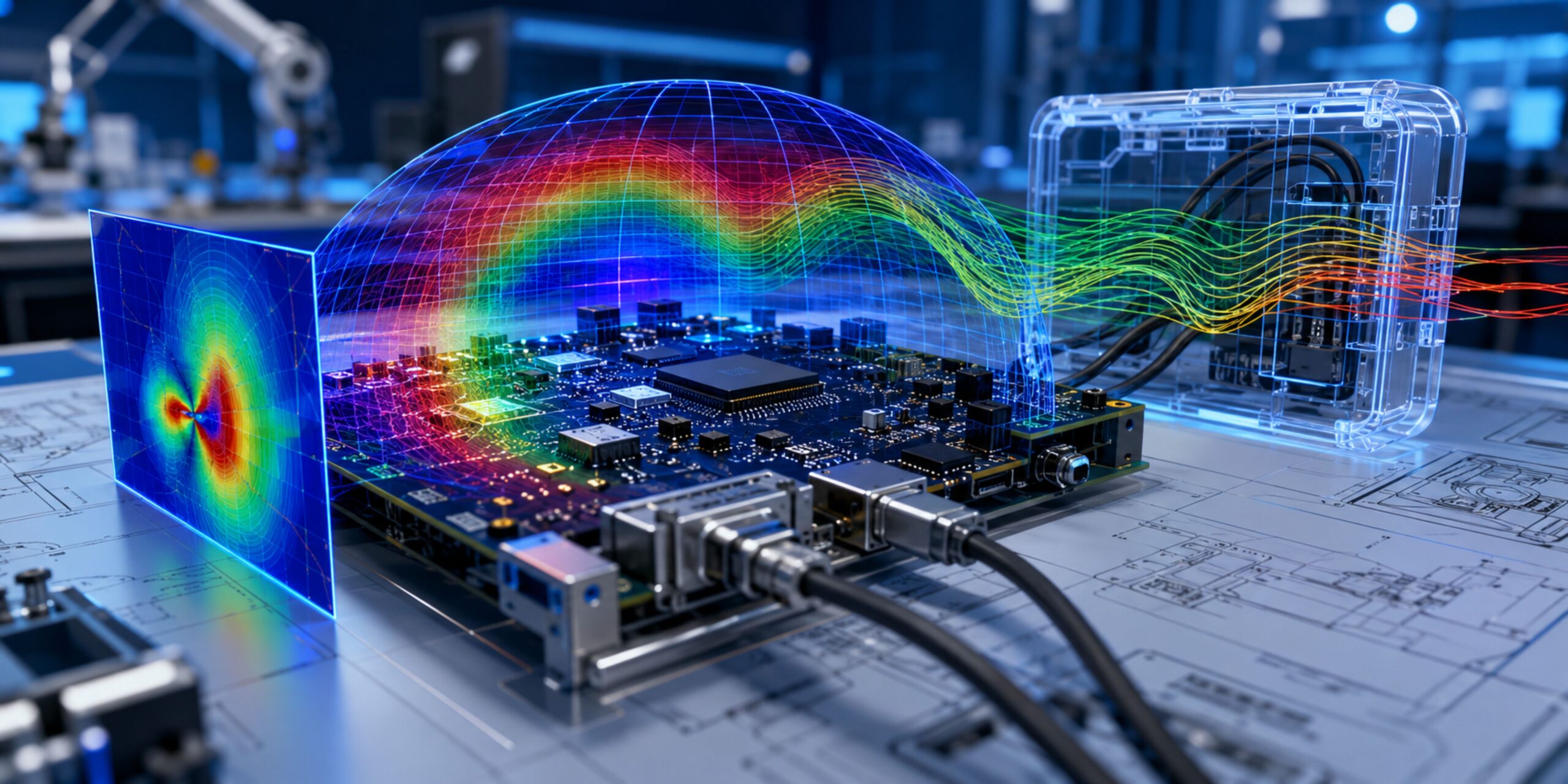
EMC/EMI simulation makes it possible to identify electromagnetic risks before manufacturing physical prototypes.
Integrating electromagnetic analysis early in the design process helps engineers evaluate:
- Electromagnetic emissions,
- Susceptibility,
- Immunity,
- Shielding effectiveness,
- Antenna integration,
- Cable behavior,
- Electrostatic discharge,
- Electromagnetic propagation.
This approach reduces physical iterations, minimizes uncertainty, and allows teams to reach laboratory validation with far more mature and optimized designs.
EMC therefore becomes not just a reactive validation step, but an integrated part of the engineering process.
CST Studio Suite as a reference solution for EMC/EMI simulation
Addressing the electromagnetic complexity of modern products requires tools capable of accurately reproducing the real behavior of electronic systems.
CST Studio Suite, from Dassault Systèmes, has become one of the leading platforms for advanced electromagnetic simulation, enabling organizations to integrate EMC/EMI analysis directly into the engineering and design workflow.
The solution supports the analysis of phenomena such as:
- Electromagnetic compatibility,
- Radiated and conducted emissions,
- Antenna integration,
- Cable behavior,
- Electromagnetic shielding,
- Signal integrity,
- Related thermal effects.
This enables engineering teams to make informed decisions before physical validation and significantly reduce redesign and certification risks.
From physical testing to predictive engineering
Increasing electronic complexity is driving a shift toward more predictive, simulation-driven engineering methodologies.
Physical validation remains essential, but it is becoming increasingly important to reach laboratory testing with designs that have already been virtually optimized and evaluated.
Electromagnetic simulation helps reduce the number of prototypes, accelerate development cycles, and improve final product quality from the earliest design stages.
How CADTECH can help
EMC/EMI simulation requires a combination of electronics engineering expertise, electromagnetic knowledge, and advanced simulation technologies.
At CADTECH, we help industrial organizations integrate electromagnetic simulation technologies into their product development processes to reduce risk, optimize designs, and accelerate validation.
Our team supports companies in implementing solutions such as CST Studio Suite, adapting simulation workflows to the specific needs of each industrial and technological environment.
Conclusion
Electromagnetic compatibility has become a critical factor in the development of increasingly complex and connected electronic products.
Integrating EMC/EMI simulation from the earliest design stages enables organizations to anticipate issues, reduce iterations, and accelerate the validation of products prepared to meet today’s technical and regulatory requirements.
comunicacion@cadtech.es – 800 007 177