
NEXT GEN ENGINEERS
Conversations with the teams shaping the future of engineering.
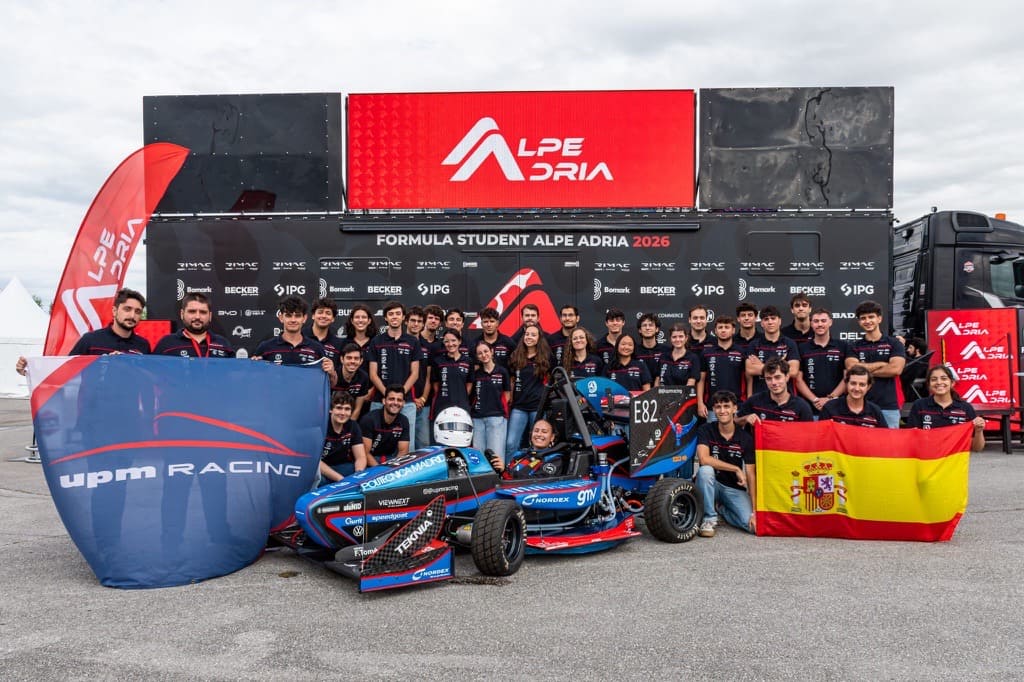
(Photo © UPM Racing)
Designing a Formula Student race car means turning university knowledge into a vehicle capable of competing: from the initial calculations to on-track testing.
In this edition of Next Gen Engineers, we meet UPM Racing, the team from the Universidad Politécnica de Madrid that brings together around 70 students and pioneered Formula Student in Spain.
We speak with Samuel Díez, Team Captain of UPM Racing, about their UPM06e electric race car, the challenges of engineering and competition, and the role of CATIA and 3DEXPERIENCE, tools for which CT CADTECH provides the team with training and technical support.
UPM Racing: More than two decades of training engineers
Christian Horta: How did UPM Racing get started, and how has it evolved into the race car you have today?
Samuel Díez:
UPM Racing was founded in late 2003 as Spain’s first Formula Student team. Today, we bring together around 70 students from different schools and engineering disciplines at the Universidad Politéctica de Madrid
We design, build, and test our own race car to compete against universities from around the world. We handle the entire process, from calculations and design to assembly, fine-tuning, and securing sponsors.
We started with combustion-engine vehicles and tubular chassis, but in 2017 we made the leap to a fully electric race car, featuring a carbon fiber monocoque and one motor per wheel. That transition pushed us to develop new capabilities in composite materials, batteries, electronics, and control systems, ultimately leading to the UPM06e.
Formula Student brings us closer to professional engineering practice: every decision has to work not only on paper, but also during manufacturing and on the track. For us, it’s an opportunity to take on responsibilities and learn by solving real-world problems.

(Photo © UPM Racing)
Christian: How is your team organized, and what motivates you to participate?
Samuel:
We’re organized into eight divisions: Aerodynamics and Cooling, Automotive Mechanics, Business Engineering, Chassis, Dynamics, Driverless, High Voltage, and Low Voltage. Each has its own responsibilities, but they all need to coordinate because any change can affect other systems.
What attracted us was the opportunity to build a race car while studying. Designing, manufacturing, and seeing all the systems work together is very different from studying them separately.
The project pushes us to research, test, and learn from our mistakes. Sharing an ambitious goal and seeing the car hit the track after so many hours of work is a huge motivation.
UPM06e: A new engineering challenge
Christian: What goals and improvements does the UPM06e incorporate?
Samuel:
We’re keeping the electric architecture with one motor per wheel and a carbon fiber monocoque. The UPM06e’s top priority is reliability: passing technical inspections and participating in the dynamic events.
We’ve improved the monocoque layups, replaced the wiring and electronic circuit boards, and upgraded the brakes. We’ve also introduced a new aerodynamic package and a suspension system with carbon fiber control arms.

(Photo © UPM Racing)
Christian: What advances would you highlight, and what has been the biggest technical challenge?
Samuel:
We’d highlight the suspension with carbon fiber control arms, which expands our experience with composite materials and opens up opportunities for weight reduction, as well as the new wiring system, which is more organized and easier to install, inspect, and maintain.
But the most complex challenge has been designing and building the high-voltage battery from scratch, due to its technical complexity and Formula Student’s strict safety requirements.
We had to integrate cells, electronics, wiring, and relays into a limited space while ensuring insulation, protection, and accessibility. This required close coordination between the mechanical and electrical teams and an in-depth understanding of the regulations.
Developing our own battery and getting it ready for technical inspections has been one of the project’s most valuable learning experiences.
Formula Student: Much more than racing on the track
Christian: What goals and results would you highlight in Formula Student?
Samuel:
At Formula Student UK, we compete with our autonomous driving system, developed by the Driverless division, with the ambition of challenging for the top positions.
With our electric race car, we’re focused on reliability and strong on-track performance. Our goal is to finish among the top fifteen and be the best Spanish team in the competitions we enter.
Among our achievements, we’d highlight our fourth-place overall finish in FS-AI at Formula Student UK 2024, held at Silverstone, where we were the top Spanish team and completed all ten laps of the Trackdrive event. In 2025, we finished sixth overall.
We also achieved 15th place at Formula Student Spain 2024 with the UPM05e EVO, after passing technical inspections and competing in the dynamic events.

(Photo © UPM Racing)
Christian: Beyond racing, what does Formula Student demand of you, and what does it teach you?
Samuel:
Technical inspections are among the most demanding moments: we have to demonstrate that the vehicle complies with regulations and is safe before it can hit the track, particularly when it comes to high-voltage systems, structural integrity, and brakes.
Competing against other universities allows us to discover different solutions to common problems, understand why they chose those approaches, and come back with new ideas for our own project.
Collaborative Engineering with CATIA and 3DEXPERIENCE
Christian: How do you coordinate your work, and what role does CATIA play in the design process?
Samuel:
We coordinate through biweekly meetings between team captains and division leaders. We also use work breakdown structures, following the PMBOK standard, to plan tasks, schedules, and costs.
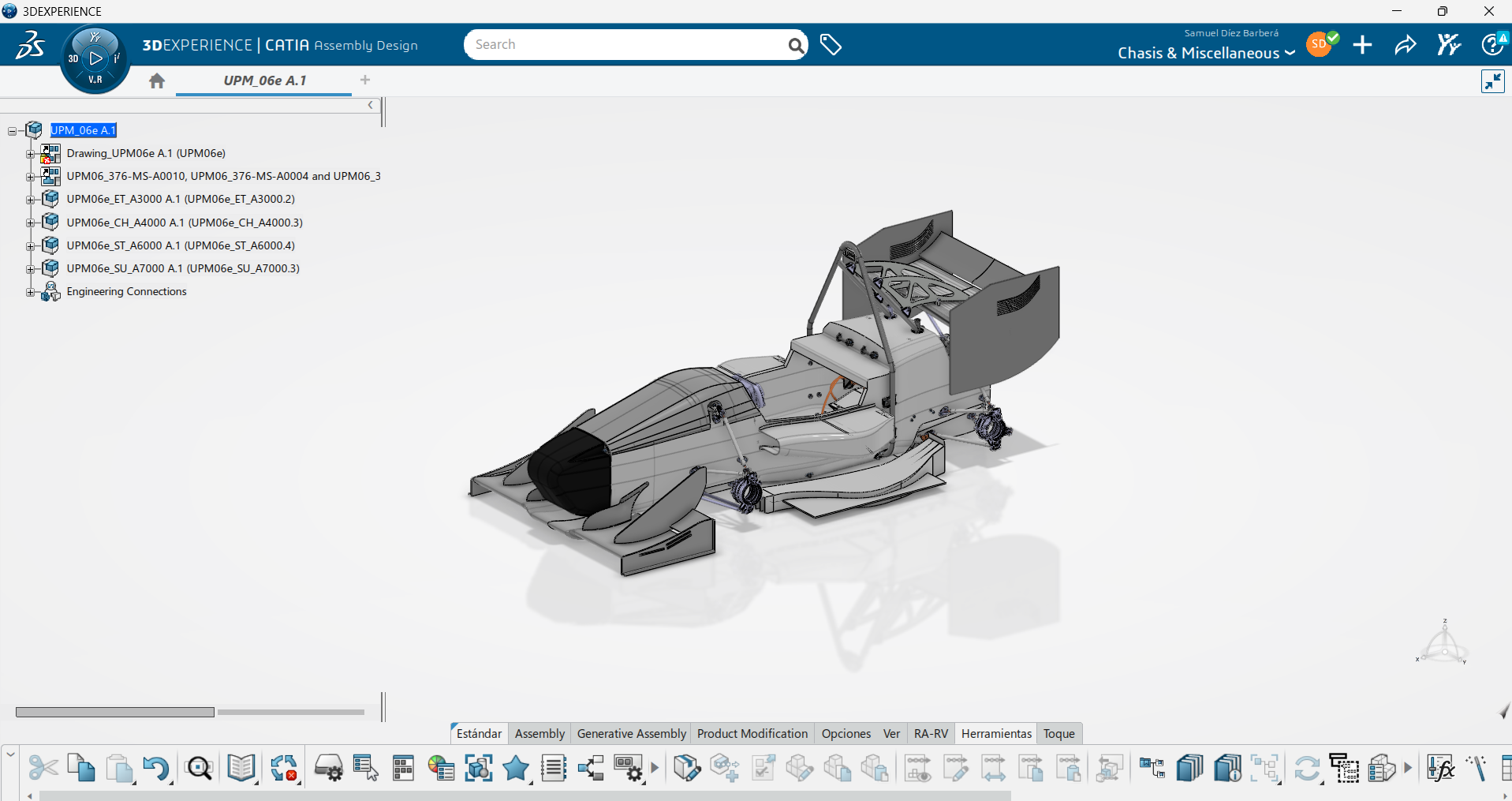
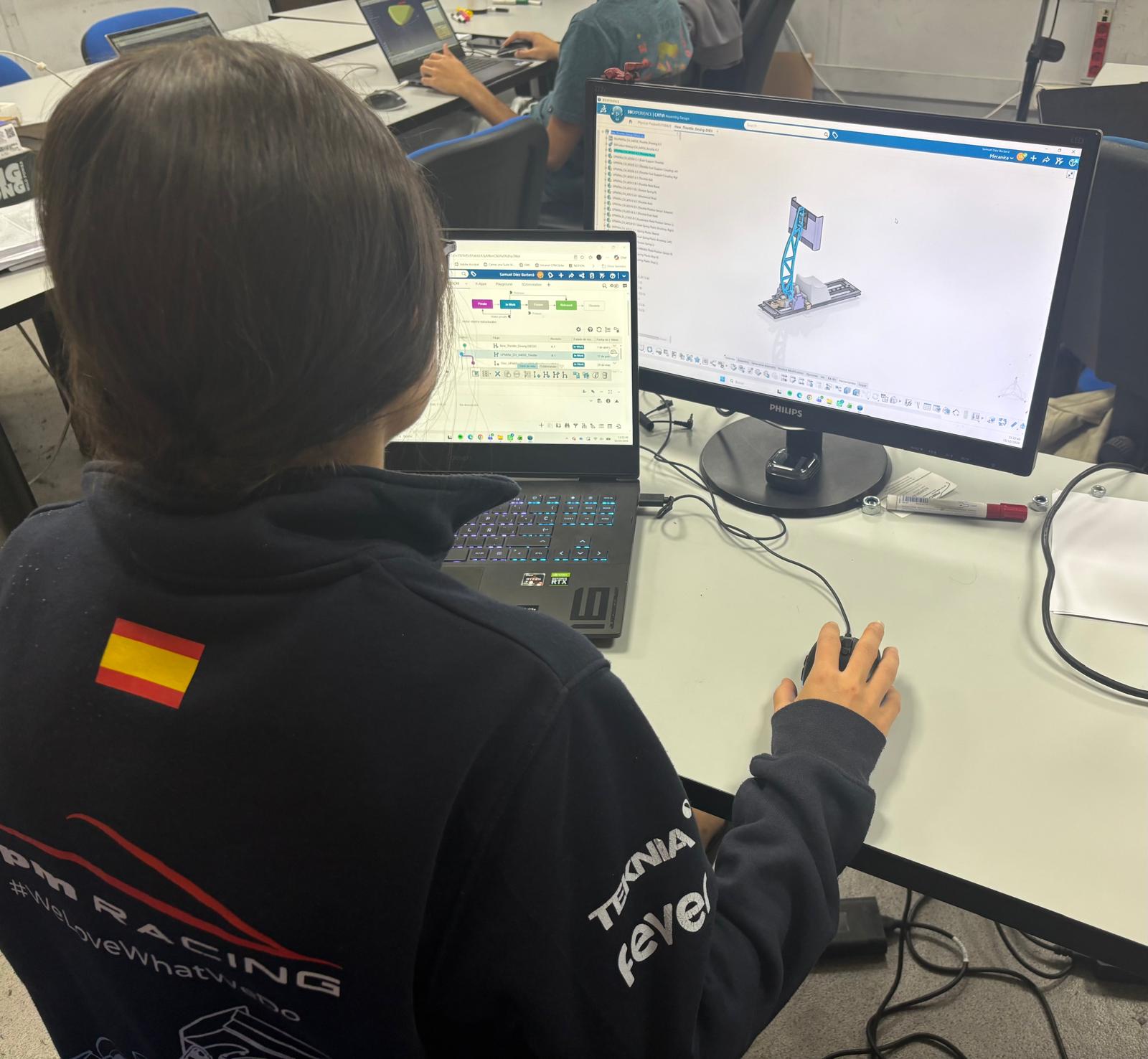
CATIA is essential: we design the components and integrate them into a complete assembly to check how everything fits together before manufacturing. This allows us to detect interferences and anticipate assembly issues between systems.
The CAD models also serve as the basis for simulations, technical drawings, and manufacturing, connecting the initial design to the actual components of the vehicle.
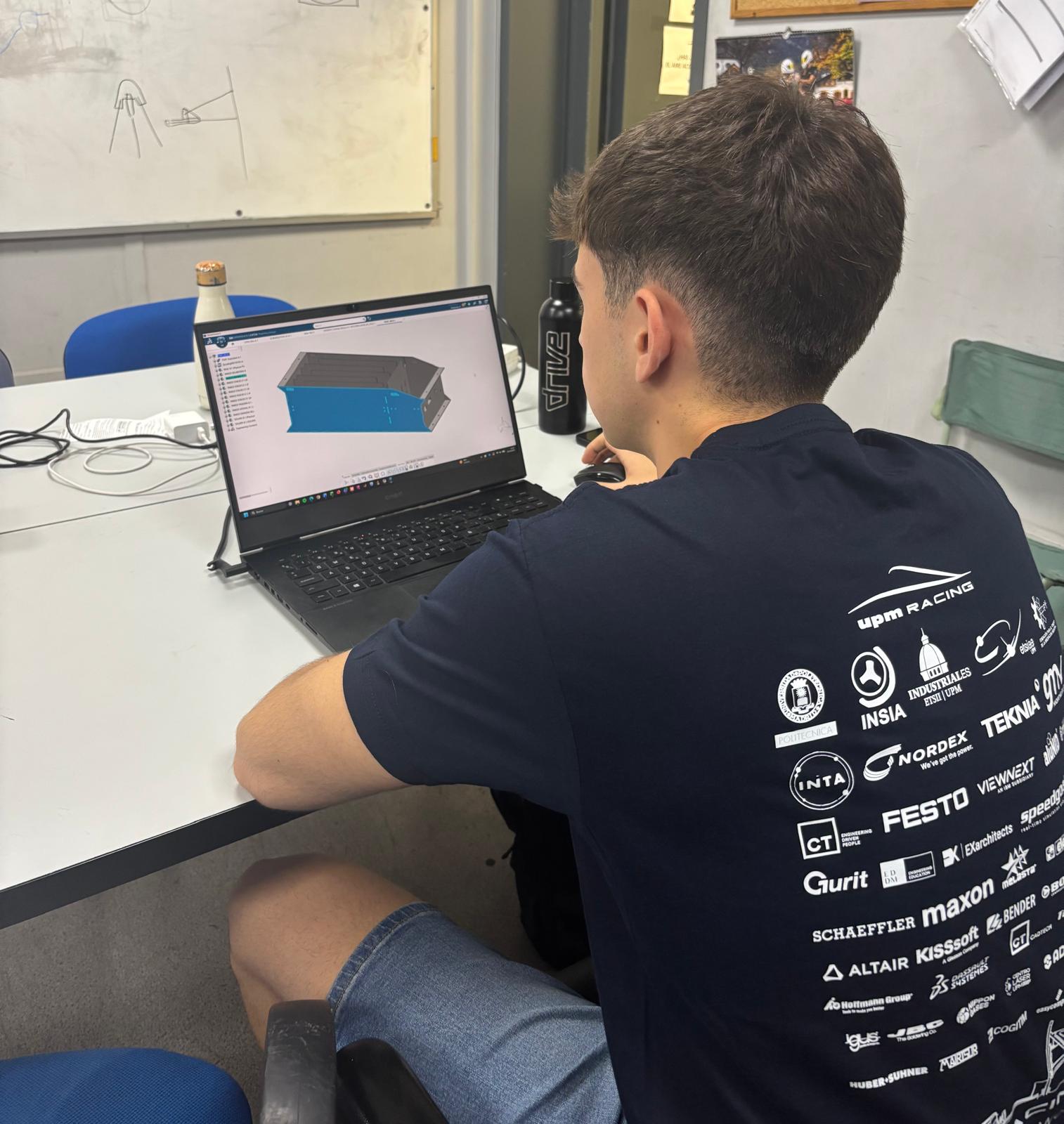
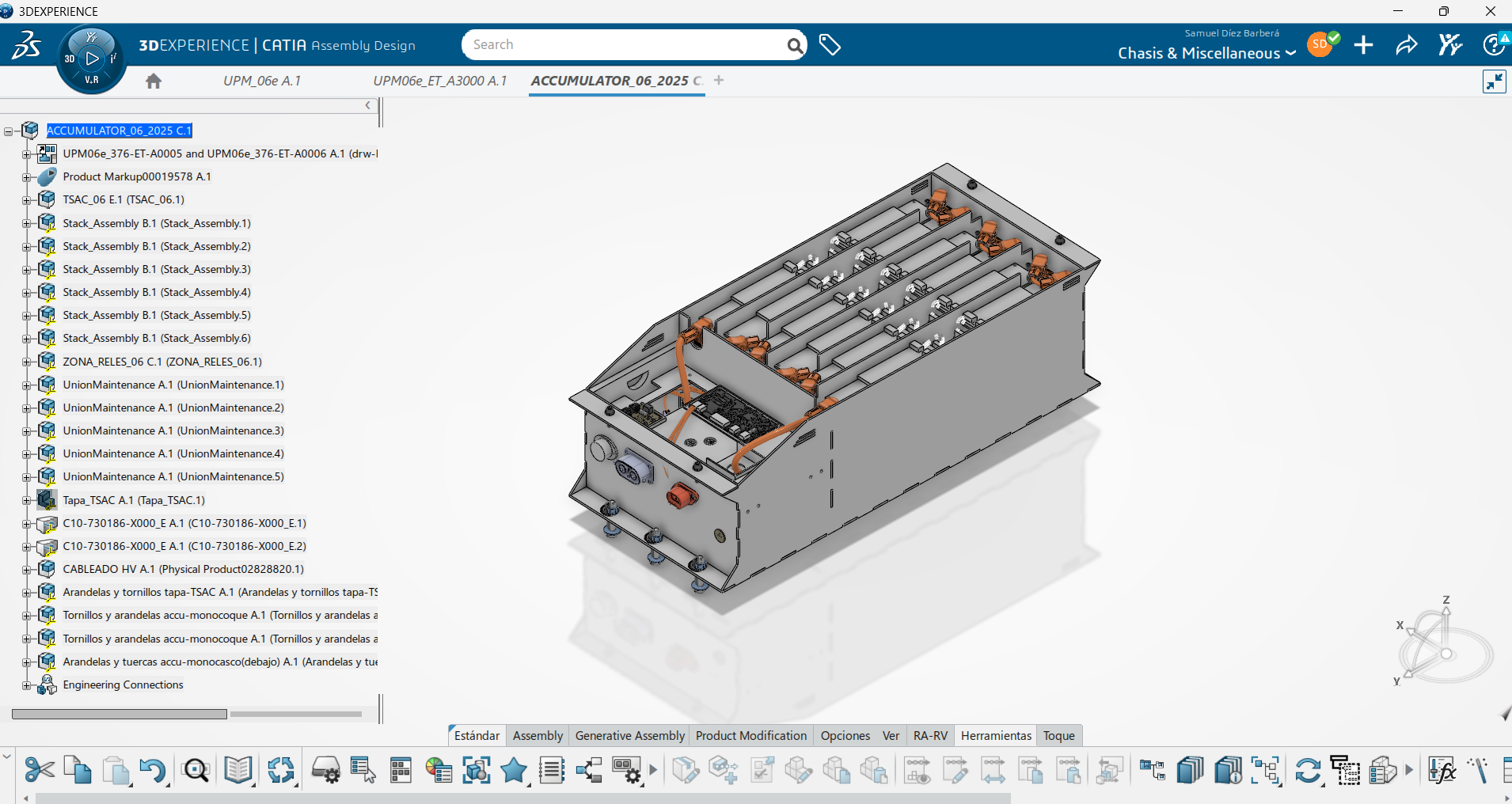
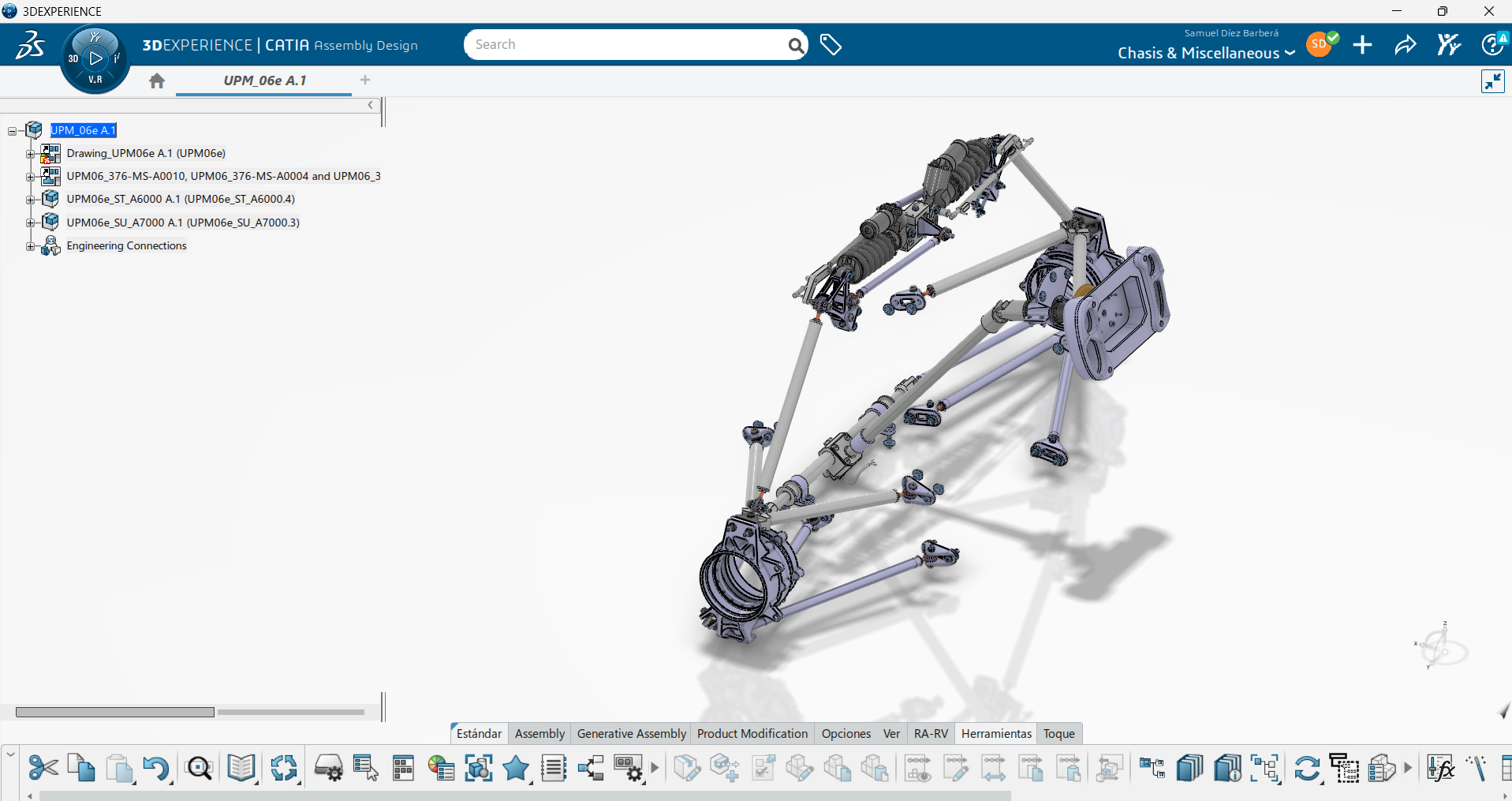
(Photos © UPM Racing)
Christian: How do you use 3DEXPERIENCE, and which features do you find most useful?
Samuel:
3DEXPERIENCE is our shared environment for organizing designs and coordinating work across divisions. It allows us to share changes and assess how they affect the rest of the vehicle.
For example, moving a component can affect its mounting brackets, wiring routes, or the space available for other systems. Working with shared information makes it easier to resolve these issues together.
In addition, keeping each season’s designs organized makes it easier to onboard new members and build on the knowledge accumulated over time.
In CATIA, we value parametric modeling, assemblies, surface design for the monocoque and aerodynamics, and manufacturing drawings. In 3DEXPERIENCE, design sharing and revision control stand out as particularly useful features.

(Photo © UPM Racing)
“The combination of these features helps us keep the design process connected to the manufacturing and assembly of the car.”
Samuel Díez, Team Captain, UPM Racing
Christian: What are the benefits of working with tools used in the industry?
Samuel:
Using professional tools while at university gives us experience that we can apply in the industry. We learn how to manage models and changes, and how to prepare designs that other team members can manufacture or build upon.
Having done this in a real-world project, with limited time and resources, gives us the discipline and confidence to take on new professional challenges.
Learning with industry tools
Christian: How would you rate the training and support provided by CT CADTECH?
Samuel:
Our experience has been very positive. Every season, new students join the team with different levels of experience, and CADTECH’s training helps us establish a common foundation in CATIA and 3DEXPERIENCE.
We’ve improved our skills in creating parts and assemblies and organizing collaborative work. Applying these tools directly to the race car makes them easier to understand and helps us learn faster.
The technical support helps us resolve questions and spend more time tackling engineering challenges, which is especially valuable when balancing the project with our studies. In addition, those who receive training can pass on their knowledge to future generations of team members.
Looking Ahead
Christian: What goals have you set for the future?
Samuel:
We want to consistently compete for the top positions, continue making progress in autonomous driving, and establish a reliable and competitive electric race car.
To achieve this, we need more testing time, data-driven decisions, and effective knowledge transfer between generations of team members.
We also want companies to see us as a team they can collaborate with and a source of future engineers with initiative and hands-on experience.
As Spain’s first Formula Student team, we aim to continue contributing to the competition and demonstrate what a group of dedicated students can achieve.
We’d like each generation to leave behind a better-prepared team, capable of taking on even greater challenges.
Discover More About UPM Racing
If you want to follow UPM Racing’s progress, discover their upcoming projects, or learn more about their activities, you can visit their official website: https://upm-racing.es/
CADTECH Communications Department
comunicacion@cadtech.es – 800 007 177