
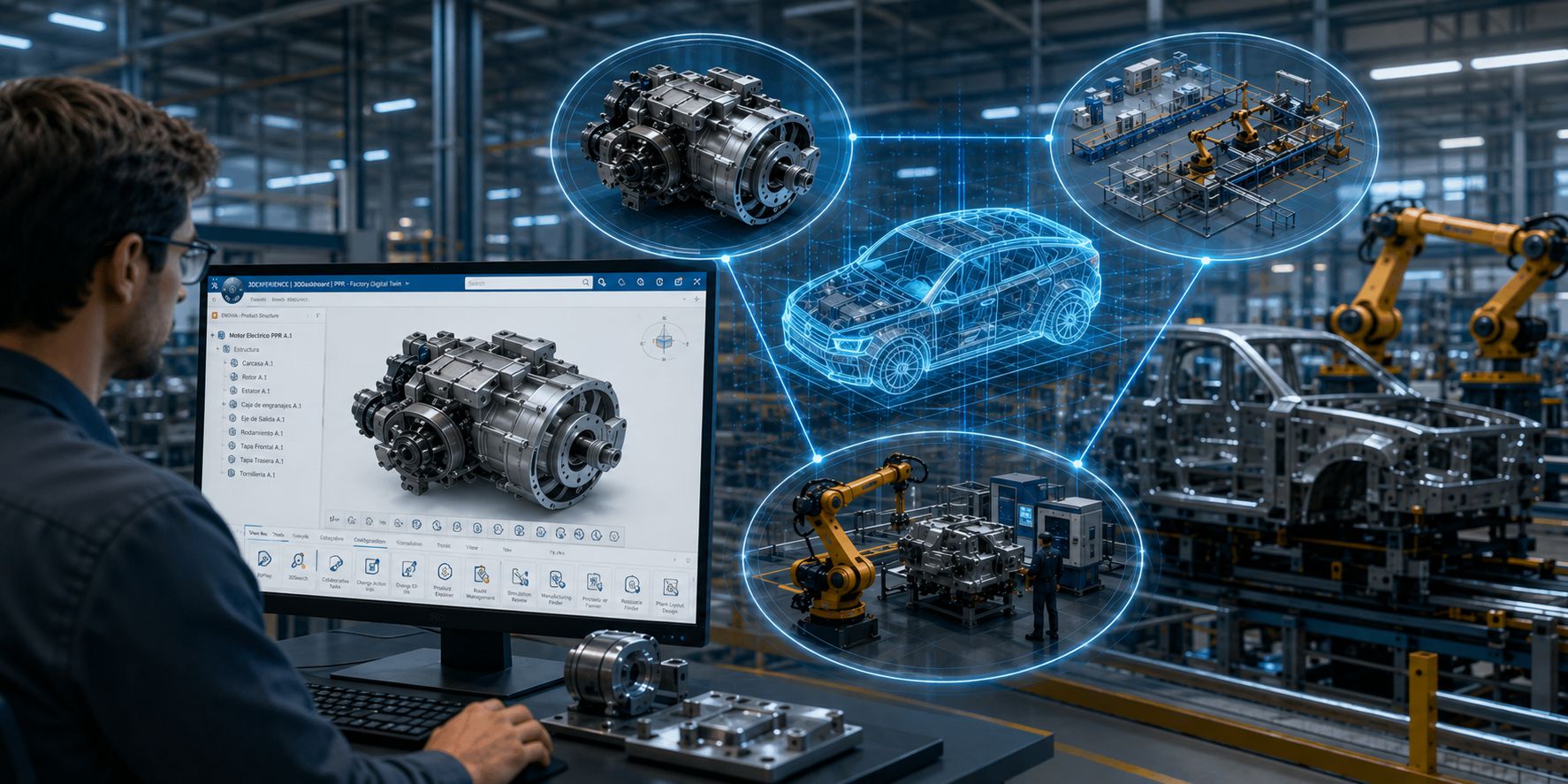
For years, many industrial companies have worked with fragmented information across engineering, production, and planning. The result is usually the same: interpretation errors, poorly synchronized changes, and decisions made without a global view of the factory.
The PPR model — Product, Process & Resource — was created precisely to solve this problem.
As Juan Carlos Portugues from Dassault Systèmes explained during our conversation at Advanced Factories, this model connects product, processes, and resources within a common digital environment.
But… what does this really mean on the shop floor?
The biggest problem in many factories: every area works separately
In many organizations:
- engineering defines the product,
- production defines how to manufacture it,
- and planning tries to coordinate resources and capabilities.
The problem arises when these worlds are not digitally connected.
That’s when the following begin:
- outdated versions,
- manual interpretations,
- manufacturing errors,
- poorly communicated changes,
- and a lack of consistency between design and execution.
The PPR model eliminates precisely that disconnect.
What does PPR mean?
Product
The complete product definition:
- structure,
- configurations,
- components,
- revisions,
- variants.
Process
How it should be manufactured:
- operations,
- assembly sequence,
- instructions,
- timings,
- validations.
Resource
With which resources it is executed:
- machines,
- tools,
- operators,
- lines,
- robots,
- available capabilities.
When these three elements are digitally connected, the factory gains consistency and responsiveness.

Validate before manufacturing
One of the most important aspects of the PPR model is the ability to virtually validate a process before bringing it to the shop floor.
This allows companies to:
- detect problems before production,
- simulate scenarios,
- evaluate capabilities,
- optimize workloads,
- and analyze the impact of engineering changes.
In other words:
the company stops reacting to problems and starts anticipating them.
Less ambiguity, more consistency
Many manufacturing issues do not arise from complex technical failures, but from something much simpler:
the information does not match across departments.
The PPR model helps eliminate that ambiguity:
- everyone works from the same information,
- changes are synchronized,
- and operations remain consistent throughout the entire product lifecycle.
DELMIA as a unified environment
As mentioned in the interview, many companies implement this approach through the DELMIA platform integrated on 3DEXPERIENCE.
This allows companies to:
- plan operations,
- validate processes,
- simulate production,
- and connect engineering and manufacturing within the same digital environment.
The result is more predictable, flexible, and efficient manufacturing.
Conclusion
The PPR model is not just a technological methodology.
It is a way to digitally connect how a product is designed with how it is actually manufactured.
And in an industrial environment where changes are constant, having that digital continuity is no longer a competitive advantage:
it is starting to become a necessity.
CADTECH Communications Department
comunicacion@cadtech.es – 800 007 177